Clinical trial listings on registries like ClinicalTrials.gov are predominantly written by clinicians and researchers for scientific or regulatory purposes. As a result, when patients or caregivers search for studies, they frequently find complex medical jargon, intricate trial designs, and dense protocol details.
To bridge this comprehension gap, TrialX introduced AI-simplified clinical trial listings to transform technical protocol descriptions into plain language. However, an AI language model works strictly with the input it is given and the instructions it receives. Optimizing these summaries requires moving beyond basic prompts to structured, highly specific prompt engineering.
Watch this webinar where we discussed how AI can help simplify complex trial content and make it more accessible for patients, along with practical examples teams can apply in real-world workflows: Designing Effective AI Prompts for Patient-Friendly Clinical Trial Listings #AIinclinicaltrials
Here is a breakdown of findings from evaluating AI-simplified trial listings, key prompt engineering strategies, and industry perspectives on managing AI-generated clinical trial content at scale.
The Challenge: Why Plain Language Matters in Clinical Trials

When patients search online for clinical trials, they are often navigating stressful health situations. While public registries contain essential information, the terminology used often creates significant barriers to access:
- Scientific Audience Focus: Terms like pharmacokinetics, subcutaneous, double-blind, placebo-controlled, dose escalation, or primary endpoints obscure basic information about what participation actually entails.
- Dense Structure: Complex eligibility criteria and trial designs make it difficult for patients to quickly determine whether a study may be a potential fit.
- Missing Practical Details: Technical summaries often emphasize scientific details over the practical experience of participation, such as study visit frequency, procedures, and drug administration methods.
Translating this content into accessible language improves patient comprehension, empowers informed decision-making, and supports recruitment efforts.
Key Observations from Reviewing AI-Simplified Listings
A detailed review of 20 AI-simplified study listings across diverse therapeutic areas—including oncology, chronic respiratory conditions, medical devices, and rare diseases—highlighted several opportunities to refine prompt structures:
1. Medical Terminology and Jargon
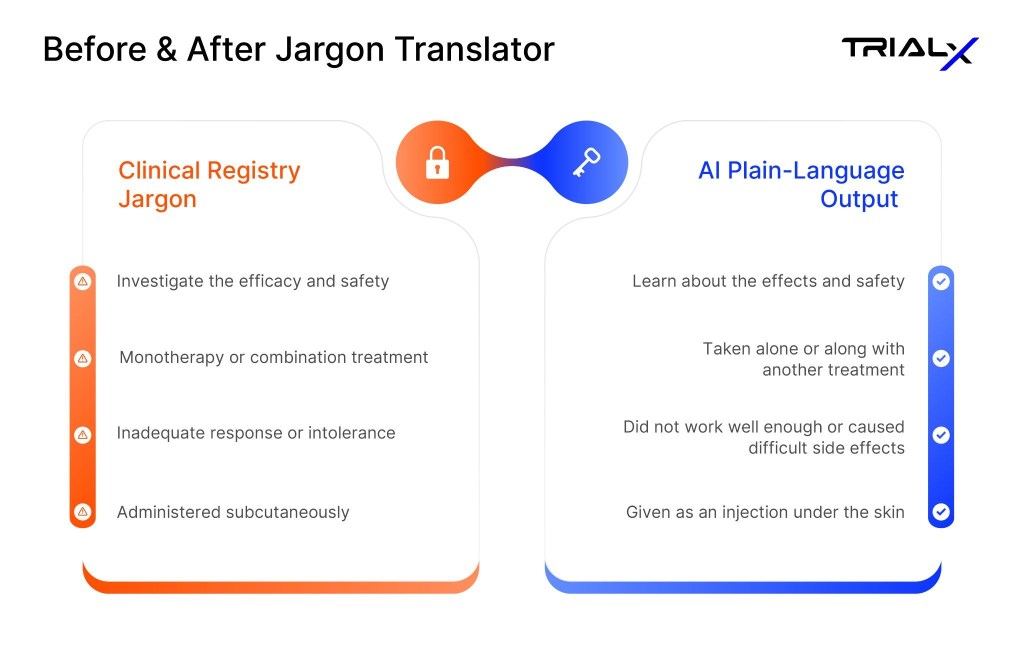
While basic AI prompts simplify text, they often retain complex phrasing or make only surface-level substitutions without adding needed context.
- Initial AI Output: “…administered subcutaneously compared to a placebo in adults with inadequately controlled COPD characterized by an eosinophilic phenotype.”
- Optimized Output: “…given as an injection under the skin for chronic obstructive pulmonary disease (COPD). The study is for adults… who have a relatively high level of eosinophils, a type of white blood cell involved with inflammation.”
2. Sentence Structure and Readability
Technical summaries often rely on long, multi-clause sentences. Breaking these into parallel bullet points or clear subject-verb structures significantly increases scannability.
3. Framing Around the Participant Experience
AI models tend to default to abstract protocol descriptions (e.g., “pivotal induction,” “maintenance period”). Patient-centered listings can assist by reframing these details around practical actions: what the participant will receive, how long treatment lasts, and what assessments are involved.
| Evaluation Area | Common Initial Pattern | Optimized Approach |
| Terminology | Retains technical terms or makes surface-level substitutions without needed context. | Replaces or briefly defines terms in plain language. |
| Study Focus | Emphasizes trial design mechanics. | Focuses on participant actions, treatments, and timelines. |
| Eligibility | Highlights narrow inclusion/exclusion criteria without context. | Groups core criteria into clear, scannable bullet points. |
Architectural Framework for an Effective AI Prompt
To ensure consistency, accuracy, and patient-friendly formatting across hundreds of clinical trials, the underlying prompt structure must go beyond simple instructions. An effective system prompt incorporates six distinct layers:
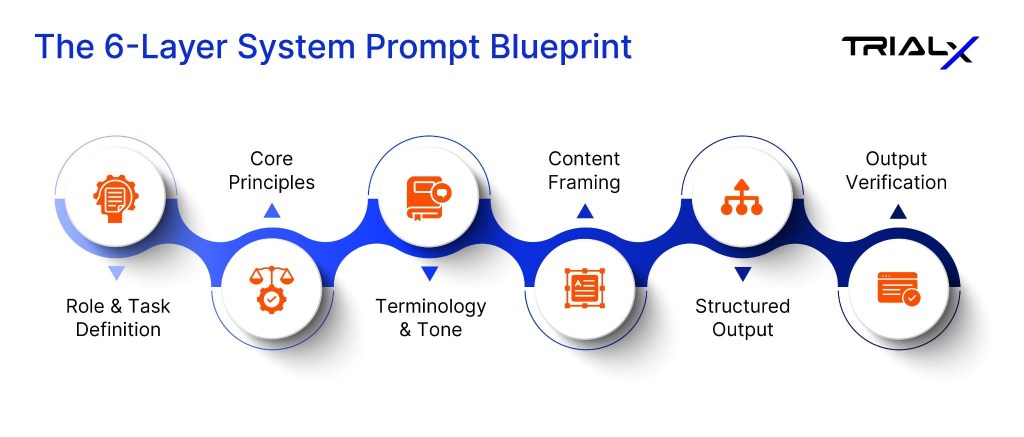
1. Role and Task Definition
Explicitly establish the AI’s identity and objective. Instruct the model that it is a specialized clinical trial communication assistant writing for potential participants and caregivers.
2. Core Operational Principles
Define boundary conditions:
- Zero Hallucination / Strict Grounding: Require the AI to rely exclusively on explicit facts from the source text. It must not infer unmentioned procedures or invent requirements.
- Respecting Source Limits: Require the AI to work strictly within the source data. If details are missing from the registry, instruct the model to state “Not specified” rather than guessing.
- A Balance Between Clarity and Brevity: Ensure the summary remains complete and informative, without unnecessary detail or length.
3. Tone and Vocabulary Rules
Establish clear translation guardrails:
- Replace technical terms with everyday alternatives (e.g., use “study medicine” instead of “investigational product”; “injection under the skin” instead of “subcutaneous administration”).
- Require a brief plain language definition when a complex medical term must be retained.
4. Content Framing Instructions
Direct the AI to structure the study description in a digestible flow for a potential participant:
- Opening Paragraph: Explain the study’s overall purpose, condition targeted, and main population.
- Body Paragraphs: Outline the treatment approach, how and when participants will receive the study treatment, and key monitoring activities, using direct phrasing (e.g., “Participants will…”).
5. Structured Formatting Standards
Enforce consistent output structure across generated listings:
- Title: Standardize the format: Study of [Study Treatment/Intervention] for [Condition].
- Who Can Participate: Use parallel bullet points detailing key eligibility criteria (e.g., age, condition, severity, prior treatment requirements).
- Study Timeline and Visits: Clearly outline the study duration, including screening, treatment, and follow up, as well as visit expectations.
6. Output Verification Rules
Include a self-correction step directing the model to audit its response against the prompt’s content guidance and formatting requirements before presenting the final text.
Webinar: Designing Effective AI Prompts for Patient-Friendly Clinical Trial Listings #AIinclinicaltrials
Practical Applications and Real-World Industry Insights
Our invited guest speaker, Krista Goedel, Clinical Digital Content Lead at Sanofi, highlighted key operational strategies for deploying AI-simplified study listings globally:
- Standardized Prompt Rules: Establishing custom, standardized rules—such as replacing technical jargon (“investigational medication”) with patient-friendly terms and clearly defining clinical concepts like “placebo”—ensures a consistent and recognizable format across hundreds of trial listings globally.
- IRB and Regulatory Alignment: Because AI summaries adapt previously approved source data (such as entries from ClinicalTrials.gov) without altering the underlying clinical facts, they do not trigger additional regulatory reviews or Institutional Review Board (IRB) approvals.
- Continuous Iteration and Patient Feedback: Deploying AI-driven simplification requires an ongoing refinement cycle. Successful global rollouts rely on running multiple prompt iterations prior to launch and continuously updating system prompts based on direct feedback from patients.
Key Takeaways for Clinical Operations and Digital Strategy Teams
- Optimize Source Data: Certain trial listing fields in ClinicalTrials.gov (such as the Brief Summary and Brief Title) are intended to be lay-friendly and can serve as the foundation for downstream AI outputs. Include the information potential participants need to know, using accessible language.
- Balance Detail and Conciseness: Overly rigid length constraints can force models to strip away important context, while loose instructions can lead to overly technical summaries.
- Structure Prompts for Scannability: Utilizing defined output templates (bullet points, clear section titles, direct verb structures) helps readers digest critical study details quickly.
By pairing clear source listings with structured prompt design, clinical trial sponsors and research institutions can make trial information far more accessible—helping patients find and understand the studies that may be right for them.
To learn more about implementing AI-simplified clinical trial listings or to schedule a demonstration, contact the TrialX team at info@trialx.com or visit TrialX.com.