Artemis II has now completed its first crewed deep-space mission and returned safely to Earth.The mission launched on April 1, completed a lunar flyby, and concluded with reentry and splashdown after roughly 10 days in space.
We haven’t had a mission like this in decades. Artemis II put astronauts back into deep space with modern systems, giving a clearer view of how humans actually perform outside low Earth orbit. For space health research, this moves things from prediction to real observation.
What Artemis II Measured During the Mission
Artemis II is primarily a systems validation mission. Human performance sat at the center of that validation.
The crew was monitored across:
- Radiation exposure beyond Earth’s magnetic field
- Sleep and circadian rhythm disruption
- Cognitive performance and reaction time
- Stress and workload under mission conditions
Most of this type of data has historically come from missions aboard the International Space Station. Artemis II extended those measurements into deep space. That shift changes what can actually be measured.
Additional Systems and Health Monitoring
Beyond physiological tracking, Artemis II also validated several systems directly tied to astronaut health and survival:
- Environmental Control and Life Support System (ECLSS), responsible for air quality, pressure, and temperature
- Orion Crew Survival System (OCSS), including launch and reentry flight suits
- Universal Waste Management System, designed for sustained crew operations
- AVATAR tissue studies, including omics-based analysis to understand epigenetic responses to spaceflight
These systems are not separate from health monitoring. They define the environment the human body is operating in.
How This Data Was Collected
Data collection on Artemis II combined:
- Wearable sensors
- Structured cognitive tasks
- Vehicle telemetry
- Pre- and post-flight biological samples
The shift is in how often data is captured.
Instead of isolated measurements, data is collected continuously. That makes it easier to track changes in fatigue, coordination, and performance across different phases of the mission.
What the Mission Showed
Artemis II reinforced something that has been difficult to fully test until now.
Deep-space operations introduce conditions that cannot be replicated on Earth or in low Earth orbit:
- Communication delays
- Higher radiation exposure
- System behavior under sustained load
- Crew response to unexpected issues
The mission also made clear how different each phase is.
Launch, deep-space transit, and reentry all place different demands on both systems and crew. Reentry in particular remains one of the most demanding phases, with extreme thermal and physical stress on the spacecraft and astronauts.
None of the issues observed during the mission were mission-ending. But they are exactly the kind of real-world signals that matter for future missions.
Tracking Artemis II in Real Time
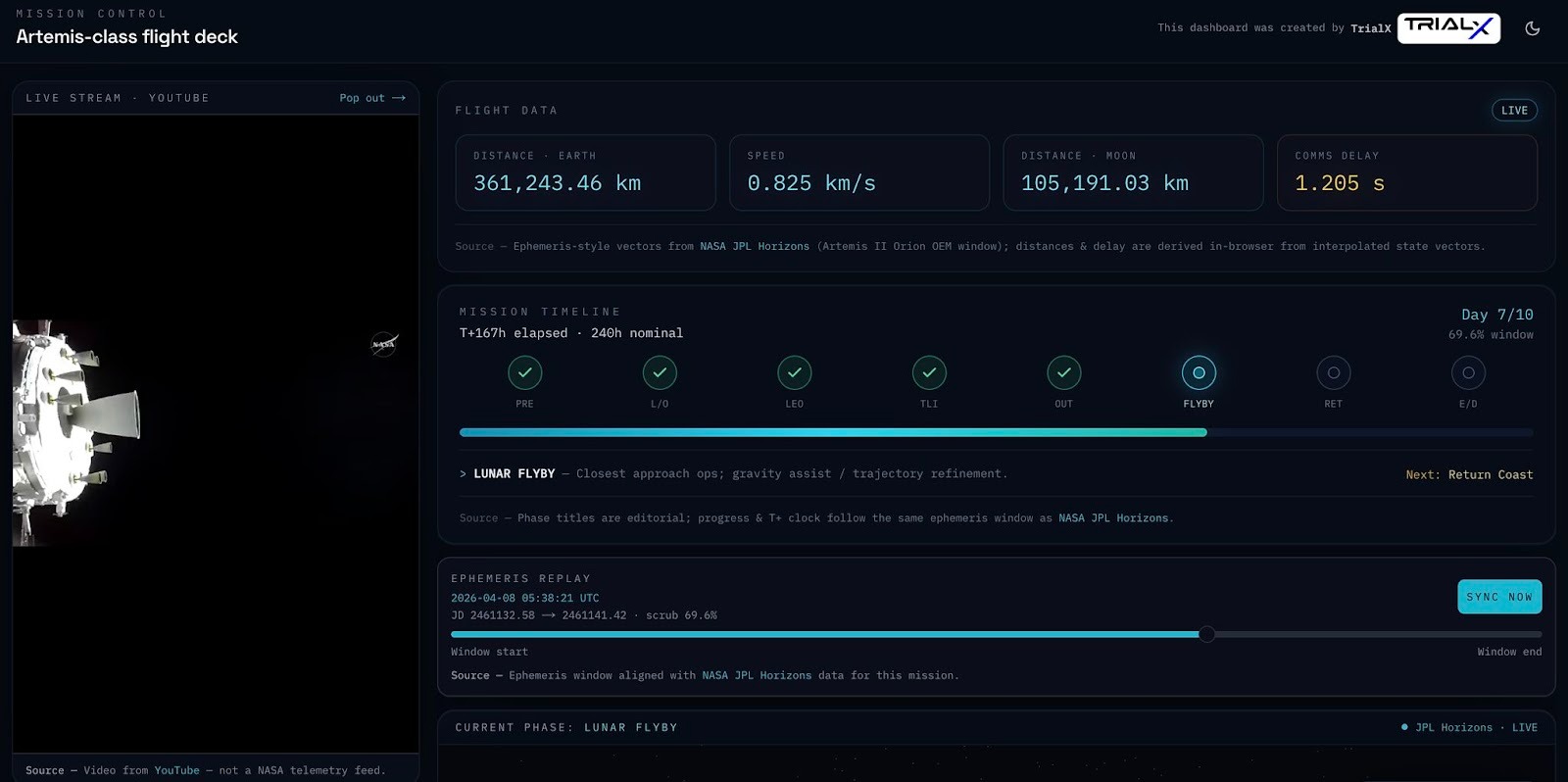
Alongside the mission, we’ve been tracking key parameters through the TrialX Artemis II dashboard.
This includes:
- Horizon trajectory and orbital path
- Space weather conditions
- Telemetry and mission status
- 3D orbit visualization
- Simulated health vitals based on mission conditions
The goal is simple. Make it easier to follow how a mission like this unfolds, and how different data streams connect over time.
The Data Gap
There is still a limitation. Data is collected, but not always unified.
- Wearable outputs
- Environmental data
- Behavioral assessments
- Biological samples
These are often handled in separate systems.
That makes it difficult to build a complete view of astronaut health across missions. As missions move further from Earth, this fragmentation becomes harder to manage.
Why This Matters
Artemis II reflects a broader shift in how space health research operates.
From:
- controlled environments
- intermittent observation
To:
- constrained environments
- continuous monitoring
This same shift is already visible in:
- remote clinical research
- low-connectivity environments
- decentralized trials
How TrialX Supports Modern Space Health Research
TrialX supports space health research through stewardship of space health data repositories, development of aerospace grade data-collection and health monitoring systems, and post-mission data analysis. At the research level, these activities are enabled by data continuity, comparison, and long-term analysis across missions.
In collaboration with the Translational Research Institute for Space Health (TRISH), TrialX presented its work on an FHIR-based space health management system for supporting long-duration space missions at the NASA Human Research Program Investigators’ Workshop (IWS 2026).
TrialX also presented “HERMES: The Art of the Possible”, demonstrating how autonomous, offline-capable health data collection can support structured research and monitoring in environments where connectivity cannot be assumed.
EXPAND Database & Biorepository
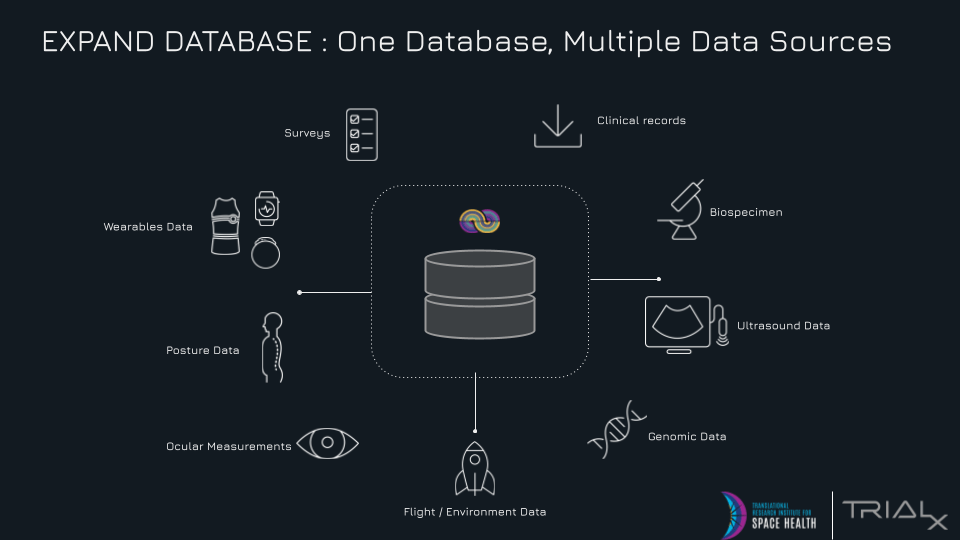
The EXPAND Database aggregates biomedical and clinical data from multiple space missions, enabling cross-mission comparisons and long-term tracking of astronaut health. Developed in collaboration with TRISH, EXPAND:
- Aggregates and curates biomedical and clinical data from multiple space missions
- Enables cross-mission comparisons and long-term tracking of astronaut health
- Supports research into cognitive performance, sleep, and behavioral adaptation
- Facilitates space medicine research and advanced astronaut health monitoring
While EXPAND focuses on aggregation and long-term analysis, reliable data capture at the source remains essential.
HERMES Platform
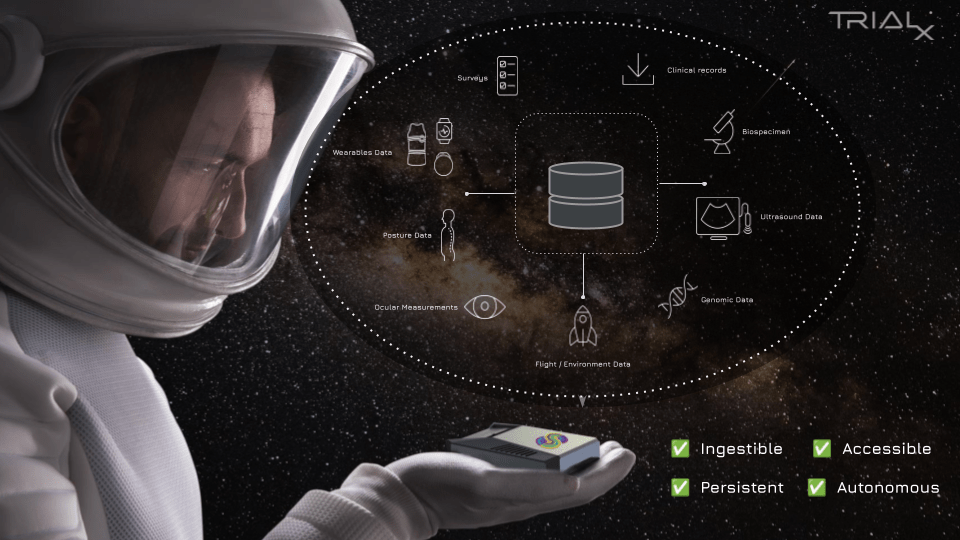
In 2023, TRISH selected TrialX to develop HERMES, an autonomous, offline-capable health data collection platform built for environments where continuous connectivity cannot be assumed.
HERMES supports:
- Real-time or delayed syncing of wearable and digital assessment data
- Structured research protocols and routine health monitoring
- Testing and validation of interventions in space-analog environments on Earth
Capabilities for Researchers
With TrialX Space Health Systems, researchers can:
- Capture and analyze longitudinal cognitive performance metrics
- Monitor emotional well-being and stress indicators over time
- Assess behavioral adaptation to isolation, confinement, and microgravity
What Artemis II Means for Space Health Research
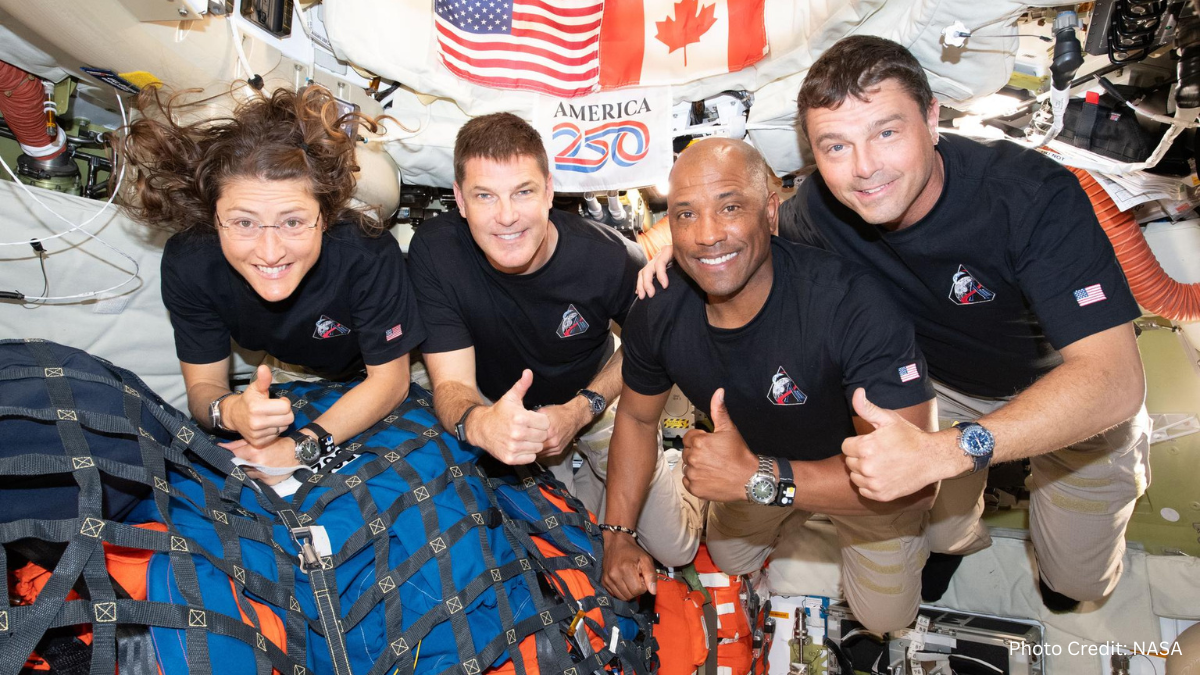
Artemis II is giving us real data on how humans perform in deep space.
That data will influence how future missions are monitored, supported, and designed. It also helps define what reliable health tracking looks like in environments where connectivity, support, and control are limited.
FAQ
What did Artemis II measure in terms of human health?
Radiation exposure, sleep patterns, cognitive performance, stress levels, and physiological adaptation in deep space.
How is Artemis II different from ISS-based research?
It operated outside Earth’s magnetic field, exposing astronauts to different radiation levels and operational constraints.
Why is continuous monitoring important in space missions?
It allows detection of subtle changes in fatigue, cognition, and performance across mission phases.
What are the biggest data challenges in space health research?
Fragmentation across systems and lack of integrated datasets.