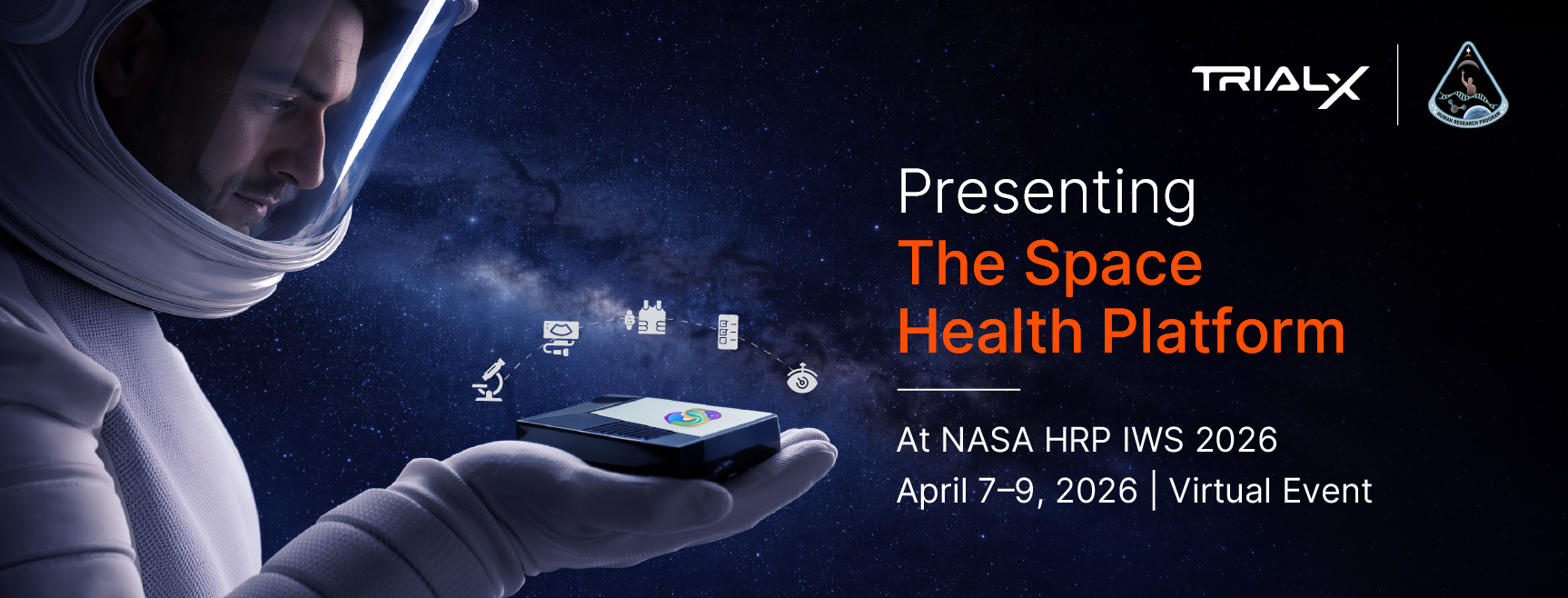
The Rise of Commercial Astronauts: What It Means for Space Health Research
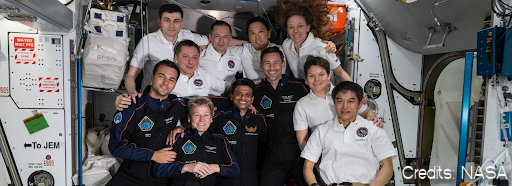
Over the past five years, the rapid commercialization of spaceflight, led by companies like SpaceX, Axiom Space, and Blue Origin, has transformed who can go to space. This shift has introduced a new category of explorers: commercial astronauts, individuals flying through privately operated missions.
Where once space was primarily the domain of government agencies like NASA, Roscosmos, or ESA, it is now opening up to a much broader group of participants.
With this shift comes a profound opportunity for space health research.
Who Are Commercial Astronauts?
Commercial astronauts are people who travel to space through private spaceflight missions, not as government employees, but as civilians, professionals, scientists, or investors. They include:
- Medical professionals (e.g., Hayley Arceneaux, physician assistant and cancer survivor)
- Scientists and researchers (e.g., Dr. Sian Proctor, geoscientist)
- Entrepreneurs and mission sponsors (e.g., Jared Isaacman, billionaire pilot)
- Educators and artists
- Military-trained pilots flying commercially
They bring diversity in age, gender, ethnicity, health status, and background. This range is essential for understanding how space affects different human bodies.
Why This Diversity Matters for Space Health Research
In the past, most space health data came from a small group of highly trained government astronauts. Today, the inclusion of commercial astronauts offers researchers the chance to study a broader spectrum of human responses to spaceflight conditions such as:
- Microgravity
- Radiation exposure
- Disrupted circadian rhythms
- Isolation and confinement
- Physical deconditioning
More variation means more data points, which leads to better medical preparation for future missions to the Moon, to Mars, and beyond.
As the diversity of astronauts increases, so does our understanding of how space affects human health and behavior.
Dr. Mathias Basner of the University of Pennsylvania, a leading expert in space behavioral health, has emphasized the importance of studying civilian astronauts to uncover how cognition, behavior, and medication responses change in microgravity. In our CureTalks conversation, “Understanding the Effects of Space Missions on Human Health and Behavior”, Dr. Basner highlights how commercial missions are unlocking insights that were previously difficult to study.
Commercial Space Missions Supported by TrialX
Inspiration4 (2021)
Astronauts:
- Jared Isaacman – Mission sponsor and commander
- Hayley Arceneaux – Pediatric cancer survivor, physician assistant
- Dr. Sian Proctor – Geoscientist, educator, artist
- Chris Sembroski – U.S. Air Force veteran, aerospace engineer
Health Research Facilitated by TrialX: Cognition, Posture, Ultrasound, Telemetry, DNA/RNA Sequences, Wearables (Apple Watch)
MS-20 (2021)
Astronauts:
- Yusaku Maezawa – Japanese entrepreneur and art patron
- Yozo Hirano – Production assistant and documentarian
Health Research Facilitated by TrialX: Cognition, Posture, Autorefractor Data, Wearables (Apple Watch)
Axiom Mission 1 (Ax-1) (2022)
Astronauts:
- Michael López-Alegría – Former NASA astronaut, Ax-1 commander
- Larry Connor – Entrepreneur and private pilot
- Eytan Stibbe – Former Israeli fighter pilot, philanthropist
- Mark Pathy – Canadian investor, philanthropist
Health Research Facilitated by TrialX: Cognition, Posture, Autorefractor Data, Wearables (Apple Watch)
Axiom Mission 2 (Ax-2) (2023)
Astronauts:
- Peggy Whitson – Former NASA astronaut, Ax-2 commander
- John Shoffner – Pilot and STEM advocate
- Ali Alqarni – Royal Saudi Air Force pilot
- Rayyanah Barnawi – First female Saudi astronaut
Health Research Facilitated by TrialX: Cognition, Posture & Motion, Space Omics, Field Test Data, TRISH Essential Measures, Wearables (Garmin, BioButton, Apple Watch)
Axiom Mission 3 (Ax-3) (2024)
Astronauts:
- Walter Villadei – Italian Air Force Colonel
- Marcus Wandt – Swedish test pilot, ESA project astronaut
- Alper Gezeravcı – Turkey’s first astronaut
- Michael López-Alegría – Commander on second commercial mission
Health Research Facilitated by TrialX: Cognition, Posture, TRISH Essential Measures, Wearables (Garmin, BioButton)
Polaris Dawn (2024)
Astronauts:
- Jared Isaacman – Mission sponsor and commander
- Scott “Kidd” Poteet – Former U.S. Air Force Thunderbird pilot
- Sarah Gillis – SpaceX astronaut trainer
- Anna Menon – SpaceX biomedical engineer and mission director
Health Research Facilitated by TrialX: Cognition, Posture, Ocular, SANS Surveillance, Field Test, Ultrasound, Space Omics, Radiation Measurement, TRISH Essential Measures, Wearables (Garmin, BioButton)
Fram2 (2025)
Astronauts:
- Chun Wang – Crypto entrepreneur and mission sponsor
- Jannicke Mikkelsen – Norwegian filmmaker and polar explorer
- Rabea Rogge – German robotics engineer, first German woman in orbit
- Eric Philips – Polar explorer and expedition medic
Health Research Facilitated by TrialX: Cognition, Physiology, Stress, Heart Rate, Respiration Rate, SpO₂, Space Omics, Wearables (Garmin, BioButton)
Axiom Mission 4 (Ax-4) (2025)
Astronauts:
- Peggy Whitson – Former NASA astronaut, Ax-4 commander
- Group Captain Shubhanshu Shukla – Indian Air Force test pilot
- Sławosz Uznański-Wiśniewski – Polish ESA project astronaut
- Tibor Kapu – Hungarian mechanical engineer and ESA project astronaut
Health Research Facilitated by TrialX: Cognition, Sleep Cycles, Genome Changes, Cognitive Workload, Eye & Brain Health, Cardiovascular Metrics (HR, HRV, SpO₂), Temperature, Step Count, Myogenesis, Organoid Studies, Wearables (Garmin, BioButton), TRISH Essential Measures
Tools for Space Health Research, Data Collection and Management
TrialX GO: Smart Health Monitoring
TrialX GO is an AI-powered, offline-capable health data server currently under development. Built for space missions where connectivity is limited or unavailable, it is designed to:
- Run real-time diagnostics and health monitoring
- Analyze inputs from wearables and medical devices using AI
- Store health data securely in an encrypted “cold health wallet”
- Share data across habitats, spacecraft, and equipment once bandwidth is restored
By operating directly on edge devices, TrialX GO allows astronauts to monitor health, receive alerts, and manage data even when disconnected from Earth. Once connectivity resumes, data syncs seamlessly to the EXPAND Database.
EXPAND: The First-of-Its-Kind Space Health Research Repository
In 2021, the Translational Research Institute for Space Health (TRISH) selected TrialX to build the EXPAND Database and Biorepository to house clinical research and flight data from commercial astronaut missions. Since then, EXPAND has become a centralized system supporting seven missions to date.
The EXPAND Database enables:
- Secure storage of physiological, cognitive, genetic, and behavioral data
- Integration with devices like Butterfly iQ+ ultrasound, BioButton, Garmin wearables
- Data collection from surveys, logs, and clinical instruments like Essential Measures
- Cross-mission data access through the EXPAND Data Portal
Researchers can explore datasets from missions like Inspiration4 and Polaris Dawn, analyze trends in astronaut health, and apply findings to future crewed spaceflights.
TrialX at NASA’s IWS 2025: Showcasing Innovations in Space Health Research
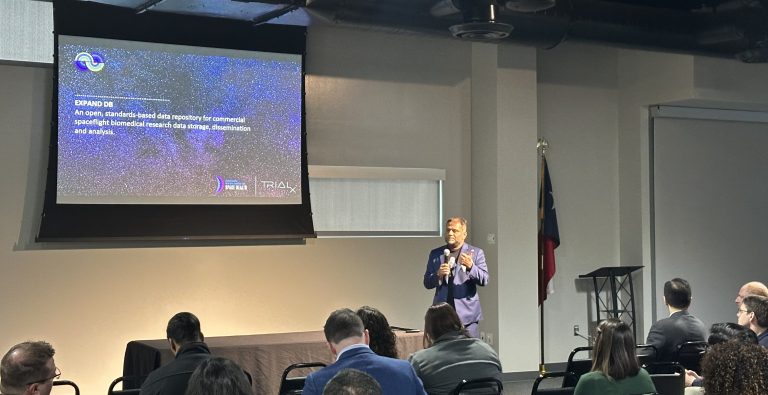
As part of our ongoing work in advancing space health research, TrialX was invited to present at the NASA Human Research Program’s 2025 Investigators’ Workshop (IWS). Our Co-founder & CEO, Sharib Khan, showcased the groundbreaking EXPAND Database & Biorepository—developed in collaboration with the Translational Research Institute for Space Health (TRISH)—to support data collection from commercial spaceflight missions.
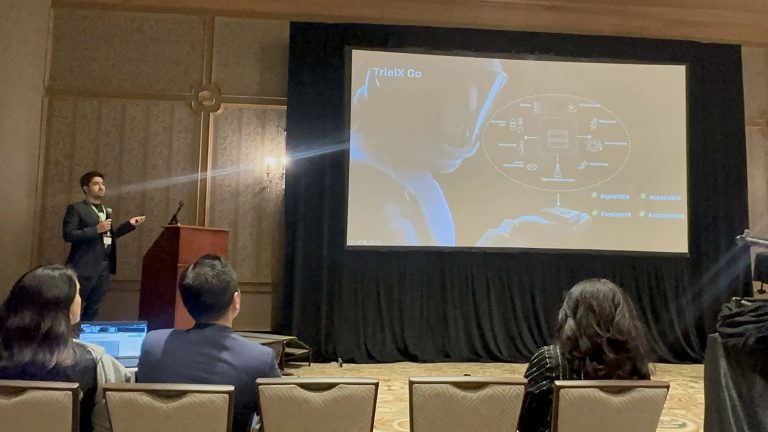
Dr. Chintan Patel, our CTO & Co-founder, and lead engineer Syed Gufran also showcased the HERMES platform, an innovative system for securely collecting and transferring health data during space missions. Read more here.
What the Commercialization of Spaceflight Means
- More missions create more opportunities to study health in space
- More astronaut types lead to broader, more inclusive datasets
- More autonomy allows astronauts to run studies without ground support
- More innovation from public-private partnerships speeds up research
Private spaceflight is revolutionizing both who goes to space and how research is conducted there.
The commercial space age is here, and with it comes a more human-centered, scalable approach to health research. Astronauts now carry the tools to collect data on their own health, even in deep space.
Through TrialX GO and the EXPAND Database, TrialX is enabling this transformation—helping researchers build a more complete picture of how the human body responds to life beyond Earth.
Explore how our Remote Data Collection Platform is supporting research across missions.