Making Clinical Trials More Inclusive With AI-Powered Tools
Making clinical trials more diverse isn’t just the right thing to do — it’s essential for developing treatments that work for everyone. Yet, despite FDA guidance, many trials still fail to reflect the real-world diversity of patients. A recent analysis of Phase III Alzheimer’s trials in the U.S. found that nearly 90% of participants were White, with less than 1% Black and under 5% Native American or Asian/Pacific Islander.
Barriers like a lack of trust, limited access, and minimal outreach continue to exclude underrepresented communities. At Patients as Partners 2025 and DIA 2025, the call to action was clear — we must move beyond traditional recruitment strategies to ensure equity in research.
At TrialX, we’re working to make participation easier for all patients by combining smart technology like AI with human understanding. From remote trial access and multilingual study experiences to simplified, 8th and 5th grade literacy tools, our platforms help participants prescreen and connect with study teams — often in just a few clicks. We believe combining the power of AI with human insight is key to driving inclusion, and one example of our commitment is our collaboration with the Reflections Collective, a Fierce DEI Award winner, where we power their AI-driven clinical trial finder to help close the diversity gap in research.
In this blog, we share how we are leveraging AI to make clinical trials more diverse and inclusive.
1. Reaching the Right Participants Through Real-World Data
Traditional recruitment methods often rely on referrals from large hospitals or specialty clinics, which means patients from rural areas, local community health centers, or underserved populations are frequently left out. These gaps exist not because people are unwilling to participate, but because researchers are unable to reach the right candidates.
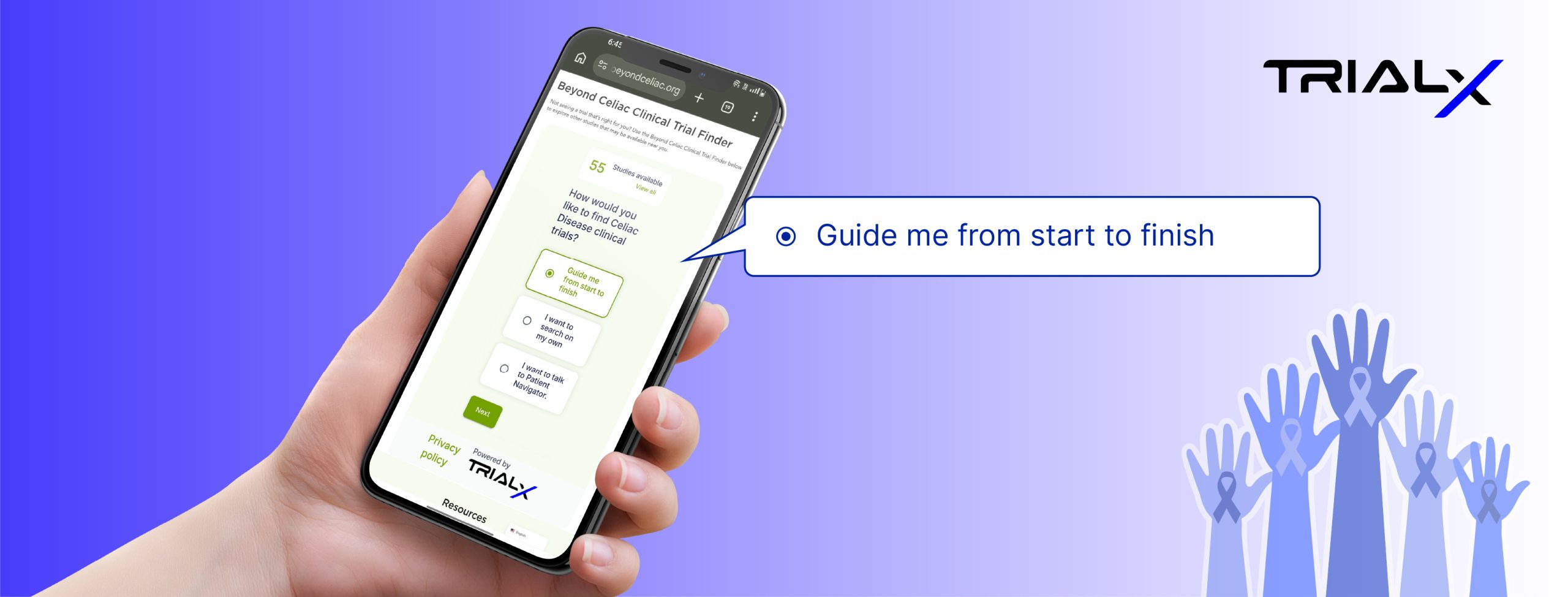
TrialX is working to bridge this gap by using real-world data and AI-powered tools that help more people find relevant clinical trial options. Instead of searching through hundreds of trials, individuals can find matches effortlessly by connecting their medical profile from an Electronic Health Record (EHR). The platform uses natural language processing to understand everyday queries like “clinical trials for migraines near Atlanta,” and returns matches based on condition, location, and personal preferences.
As Eric Sandor, our Executive Chairman, emphasized during the Patients as Partners EU conference,
“They’re trying to find a trial. They’re not going to come to a one-study website and do one pre-screener and then go trial by trial doing pre-screeners—they simply won’t have the staying power for that.”
This highlights the importance of building tools that screen across many studies at once.
Eric Sandor, Executive Chairman, TrialX, shares insights and experiences on “Enhancing Patient Recruitment & Engagement with AI” at the Patients and Partners Europe 2025 conference.
By making it easier for people to find, understand, and engage with trials, we are working to ensure clinical research reflects the diversity of the real world, giving more patients the chance to contribute to and benefit from science.
2. Making Trials More Accessible Through Language Simplification
Language and comprehension barriers are a major obstacle to clinical trial participation, particularly for patients who prefer to communicate in a language other than the one used at the trial site or struggle with complex medical terminology. These challenges can lead to confusion and disengagement.
A study conducted at Cedars-Sinai Medical Center analyzed over 12,000 cancer cases and found that 10% of patients identified preferred a language other than English. While English speakers enrolled in trials at a rate of 13%, participation dropped to 11% among Spanish speakers, 10% among Armenian speakers, and just 5% for Russian and Arabic speakers.
The study also revealed a critical issue in research team preparedness: despite institutional training on informed consent for patients with limited English proficiency, staff answered only 64.8% of related knowledge questions correctly, underscoring ongoing challenges in how language barriers are addressed across the trial experience.
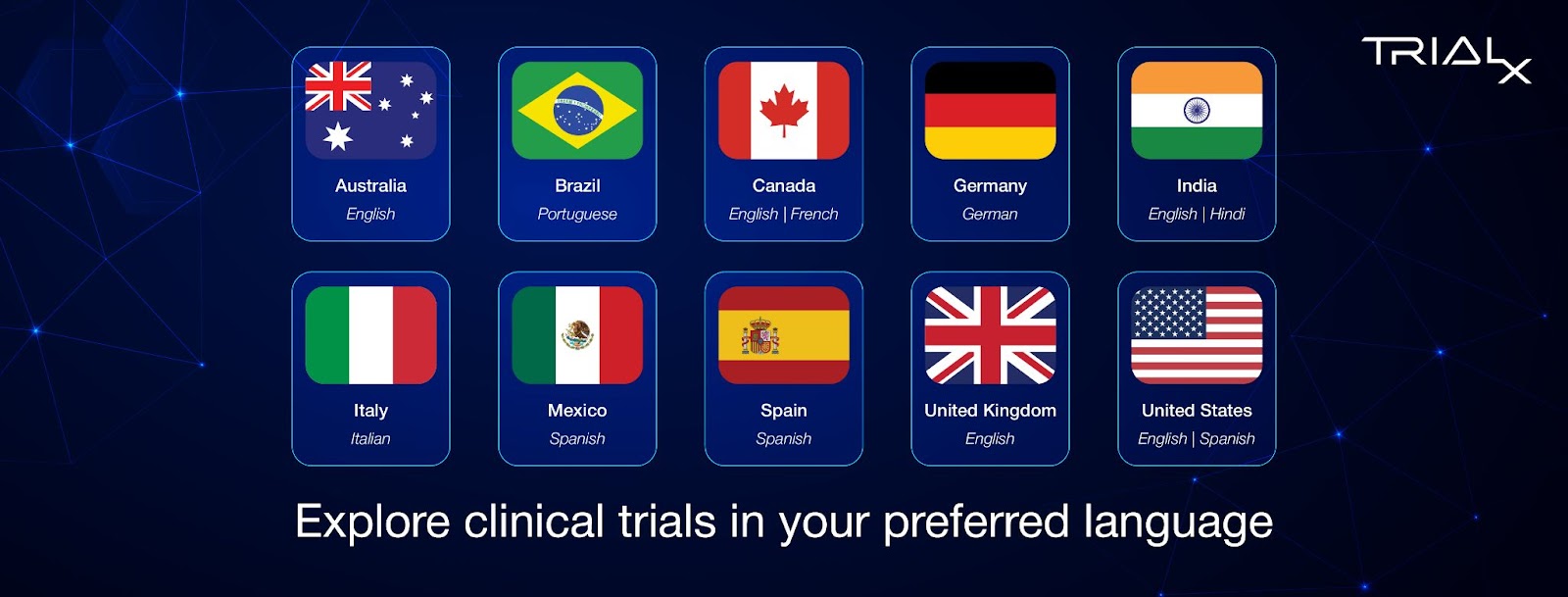
TrialX is helping bridge these gaps by enabling sponsors to design multilingual, culturally relevant study experiences. From trial landing pages to consent forms, research teams can offer content in multiple languages—such as English, Spanish, French, Italian, Hindi, Portuguese, German, and more—through a single platform.
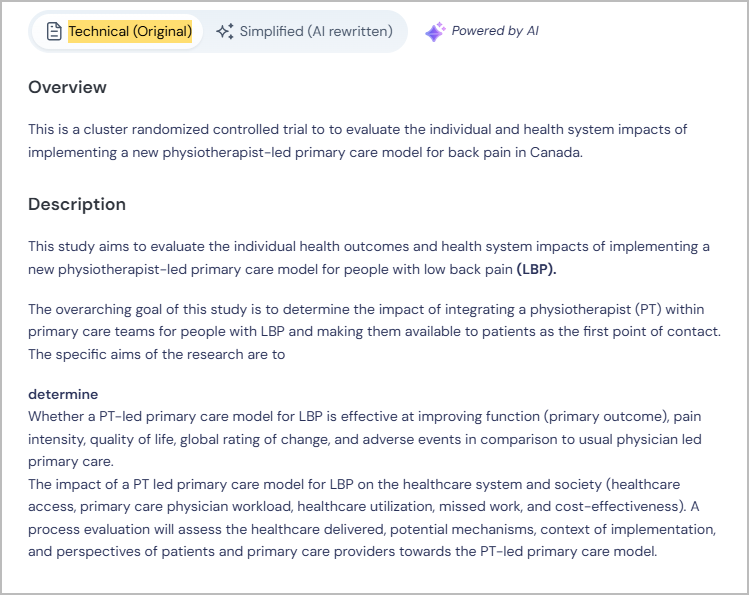
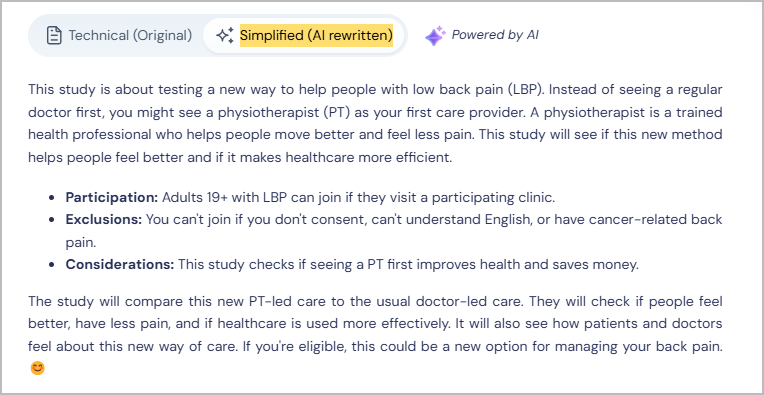
Beyond translation, our platform uses AI and natural language processing (NLP) to simplify technical content. Medical jargon is rephrased into 5th and 8th-grade reading levels, helping participants better understand what a study involves and make confident, informed decisions.
A sample clinical trial listing in its original format—difficult for most patients to understand.
A patient-friendly version generated using AI—clear and easier to understand.
By tackling both language and literacy barriers, we aim to improve participants’ understanding of trials and their trust in the process, right from the start, empowering more people to engage in research.
3. Enabling Faster, More Targeted Recruitment Across Communities
Traditional recruitment often takes a one-size-fits-all approach, which fails to engage diverse or underserved populations. Language limitations, cultural mismatches, and generic messaging contribute to low response rates and a lack of trust. We tackle this by enabling tailored recruitment campaigns across geographies, languages, and platforms.
With support for outreach in more than 15 countries and languages—including English, Spanish, Hindi, French, and Portuguese—research teams can craft culturally relevant messages delivered via email, social media, or community portals.
As our Cofounder and CEO, Sharib Khan, shared during the 2025 Patients as Partners conference:
“With generative AI, there’s no reason you can’t have study materials, ad copy, images, and outreach campaigns created and reviewed in a single day—across multiple languages.”
Sharib Khan, Co-Founder & CEO, TrialX – sharing insights on Enhancing Patient Recruitment & Engagement Through Artificial Intelligence
This rapid, localized approach transforms how trials connect with real-world populations—bringing research opportunities to more communities, faster.
Bringing more diversity to clinical trials isn’t just a matter of algorithms or outreach tactics—it requires a commitment to equity at every level. While technology plays a vital role in improving trial access and streamlining recruitment, it’s the intentional design, cultural sensitivity, and real-world understanding behind these tools that truly make an impact.
At TrialX, we’re focused on building solutions that do more than match patients to trials—we aim to reduce site burden, empower coordinators, and enable research teams to engage meaningfully with participants from all backgrounds.
To explore how TrialX can support your clinical trials, get in touch with our team here.
Every day, healthcare systems generate enormous amounts of clinical data. Diagnoses. Lab results. Imaging reports. Medications. Physician notes. Follow-up visits. Most of this information is recorded in electronic health records (EHRs)—digital systems designed to support patient…
Every March, Autoimmune Awareness Month highlights nearly 140 conditions affecting around 50 million people in the United States—many of which remain underdiagnosed and not fully understood, often leaving patients to navigate long and uncertain paths to…
As we return from an energizing week at SCOPE 2026 in Orlando, one thing is clear: the industry conversation has evolved. The focus has shifted from experimentation to execution — from “Should we modernize?” to “How…