Space Health Research in Action: Telemetric Health AI Study Monitors Heart and Balance on Ax-4 Space Mission
What happens to the human body when gravity disappears? Astronauts experience rapid cardiovascular and vestibular adaptation, which can cause dizziness, fainting, or impaired performance. The Ax-4 mission’s Telemetric Health AI (TESH) study captures these physiological changes in real time, advancing space health research and offering insights for improving Earth-based healthcare and space medicine research.
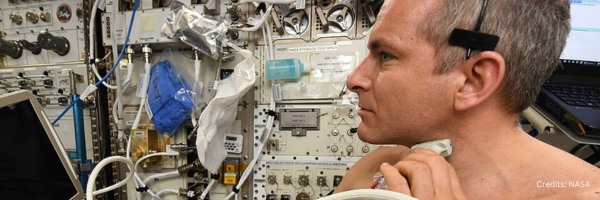
Even short missions can trigger blood pressure fluctuations or balance disorders due to microgravity health effects. Using smart monitoring shirts, continuous blood pressure sensors, and video-based motion analysis, TESH tracks heart function, vascular health, and balance with unprecedented detail.
The Challenge of Human Health in Space
Microgravity affects nearly every system in the human body:
- Cardiovascular System: Blood pools in the upper body, altering heart function and blood pressure regulation.
- Vestibular System: Balance and spatial orientation are disrupted, leading to motion sickness or impaired coordination.
- Ocular System: Spaceflight-Associated Neuro-Ocular Syndrome (SANS) can cause vision changes due to increased intracranial pressure.
These physiological changes are not exclusive to space. Aging adults and patients with cardiovascular or vestibular disorders on Earth experience similar challenges. This makes space health research directly relevant for telemedicine, remote patient monitoring, and predictive healthcare technologies.
Telemetric Health AI (TESH) Study Overview
The Telemetry System for Space Health (TESH), a HUNOR project, is a multimodal, non-invasive telemedicine platform designed to track early cardiovascular and vestibular changes in astronauts.
Key Objectives:
- Understand astronaut cardiovascular and vestibular adaptation in microgravity environments
- Detect early health risks and predict potential complications
- Support autonomous telemedicine systems for space and Earth applications
Data Collection Tools:
- Smart Monitoring Shirts: Continuous ECG, respiration, body temperature, movement, and heart rate variability
- 24-Hour Blood Pressure Monitors: Track arterial pulsations and vascular health
- Cardiac and Vascular Ultrasound: Assess heart and blood vessel function
- Video-Based Motion Analysis & Balance Tests: Measure postural control and vestibular adaptation
- Fundus Imaging: Monitor ocular changes and early signs of SANS
Key Findings from Ax-4
The TESH study is revealing crucial insights for space health research:
- Blood pressure drops and heart rate variability indicate rapid cardiovascular adaptation
- Balance and postural control tests reveal subtle vestibular adjustment patterns
- Fundus imaging detects early ocular changes linked to SANS
- AI-assisted alerts allow predictive monitoring for health risks
These findings inform countermeasures for astronauts and suggest that telemetric health AI tools can also benefit Earth-based populations, including older adults and patients with cardiovascular or balance disorders. This is a prime example of how space health technology can translate into remote patient monitoring and predictive healthcare on Earth.
TrialX Space Health Systems: Enabling Space Health Research
TrialX Space Health Systems provide the digital infrastructure to support studies like TESH, making it possible to conduct decentralized space research in low-connectivity environments.
EXPAND Database & Biorepository
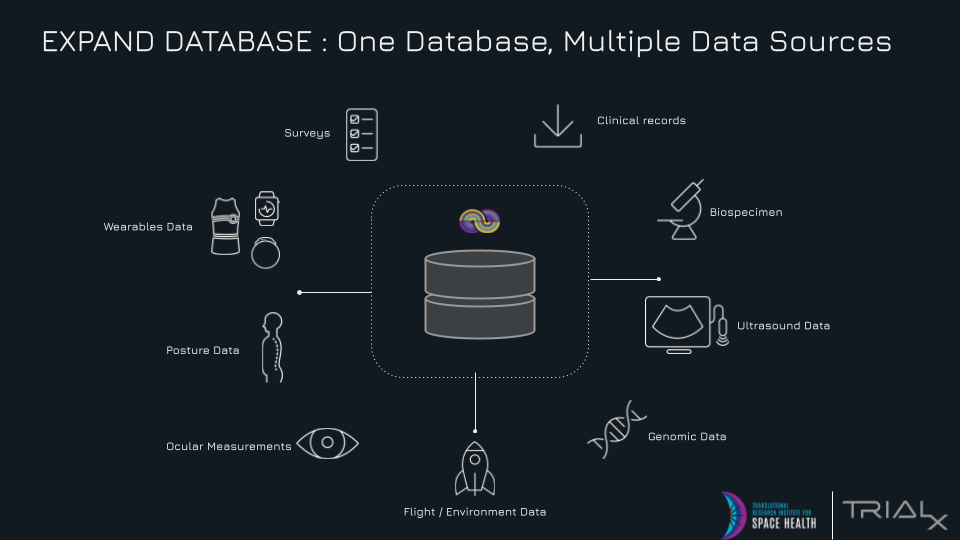
Developed in collaboration with the Translational Research Institute for Space Health (TRISH), EXPAND:
- Aggregates and curates biomedical and clinical data from multiple space missions
- Enables cross-mission comparisons and long-term tracking of astronaut health
- Supports research into cognitive performance, sleep, and behavioral adaptation
- Facilitates space medicine research and advanced astronaut health monitoring
HERMES Platform
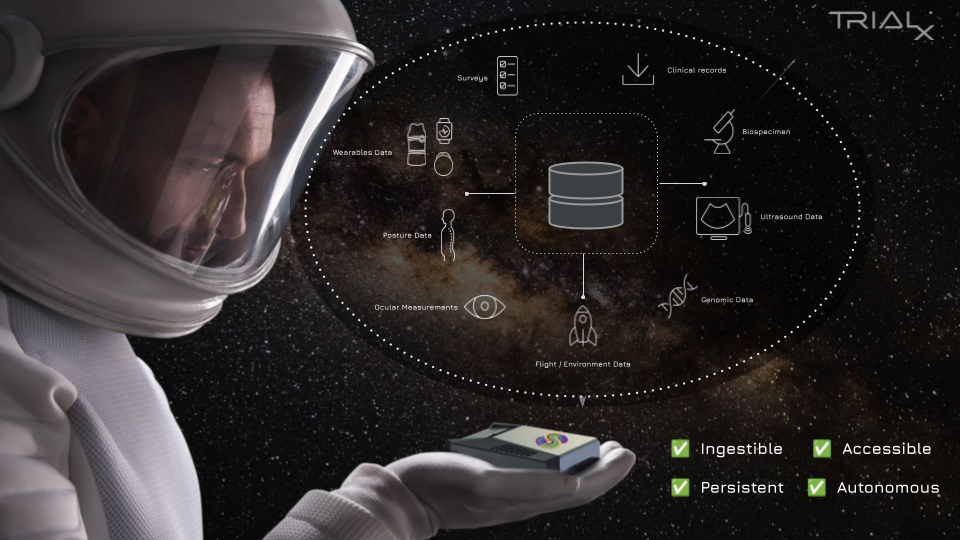
TrialX was also selected by TRISH in 2023 to develop HERMES, an autonomous, offline-capable health data collection platform that:
- Supports real-time or delayed syncing of wearable and digital assessment data
- Adapts for structured research protocols or routine health monitoring
- Enables testing and validation of interventions in analog environments on Earth
Capabilities for Researchers
With TrialX Space Health Systems, scientists can:
- Capture and analyze cognitive performance metrics
- Monitor emotional well-being and stress indicators
- Assess behavioral adaptation to isolation and microgravity
By offering scalable, AI-powered, offline-capable systems, TrialX supports studies that advance space health research, protect astronauts’ well-being on long-duration missions, and translate insights to extreme-environment applications on Earth.
TrialX’s Role in the Ax-4 Mission
On Ax-4, the crew uses TrialX EXPAND to collect surveys on TRISH Essential Measures and wearable device data on:
- Heart rate & heart rate variability
- Blood oxygen (SpO₂)
- Stress levels
- Step count and respiration rate
- Sleep summary and skin temperature
Data is securely uploaded to the EXPAND Database and Biorepository, enabling researchers to study space health trends across missions.
Implications for Earth and Future Space Missions
Insights from Ax-4 TESH and TrialX-enabled studies have broad applications:
- Remote Healthcare: AI-assisted telemedicine for underserved or remote populations
- Predictive Health Models: Early detection of cardiovascular or vestibular issues
- Aging Populations: Insights into blood pressure regulation and balance disorders
- Long-Duration Missions: Data informs countermeasures for Moon, Mars, and deep-space exploration
By translating space health research into Earth applications, TESH demonstrates dual benefits: astronaut safety and advancements in AI telemedicine, predictive health modeling, and remote health monitoring.
FAQs: Telemetric Health AI & Space Health Research
Q: What is Telemetric Health AI (TESH)?
A: A multimodal AI-driven telemedicine system monitoring astronauts’ cardiovascular and vestibular health in real-time.
Q: Why is space health research important?
A: It ensures astronaut safety, informs long-duration mission planning, and enables Earth-based healthcare innovations.
Q: How does TrialX support space health studies?
A: Platforms like EXPAND and HERMES enable secure, autonomous data collection, multi-device integration, and AI-assisted analysis for space health research studies.
Advancing Space Health Research with AI
The Ax-4 Telemetric Health AI study underscores how AI, telemedicine, and advanced digital platforms are transforming the future of astronaut care. By enabling predictive monitoring, integrating data from multiple devices, and supporting research into cognitive, cardiovascular, and behavioral health, these systems ensure astronauts remain safe and resilient on long-duration missions.
Discover how TrialX Space Health Systems can support your research or mission.