The Spacesuit as a Health System: What NASA’s Audit Reveals About Astronaut Safety
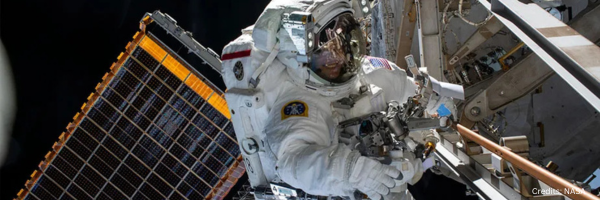
How can astronauts stay safe when life-support systems are aging and data monitoring is fragmented?
A recent NASA audit has reignited discussion about space health research. It focuses on one of the most vital systems keeping astronauts alive in space: the spacesuit. Released by the NASA Office of Inspector General (OIG) in September 2025, the report “NASA’s Management of ISS Extravehicular Activity Spacesuits” warns that the Extravehicular Mobility Units (EMUs), designed more than 50 years ago, face mounting challenges in reliability, maintenance, and component availability.
Recent events across multiple space stations further highlight these risks. Two NASA astronauts were temporarily stranded on the International Space Station when their Starliner flight suits were not compatible with Crew Dragon’s return system, and three Chinese astronauts aboard Tiangong now face delays returning home due to suit and system compatibility issues after a debris incident. These situations highlight a broader, global challenge: spacesuit interoperability and health-system integration have become mission-critical issues for astronaut safety.
These suits are more than protective shells. They are miniature, mobile health systems that manage oxygen, carbon dioxide, pressure, and temperature to keep astronauts alive in the vacuum of space. Yet as NASA prepares for longer missions to the Moon and Mars, the audit reveals gaps in how these health systems are maintained, monitored, and integrated across mission hardware.
Why NASA’s Audit Matters
NASA’s Extravehicular Mobility Units (EMUs) have supported spacewalks for decades, but the OIG report highlights declining contractor performance and supply issues with key life-support components. Collins Aerospace, the contractor responsible for maintenance and logistics, has faced increasing delays and quality concerns in recent years.
With the suits approaching the limits of their lifespan, NASA faces a difficult balancing act: keeping astronauts safe with aging hardware while developing next-generation spacesuits for upcoming Artemis missions.
The audit reveals a critical truth: astronaut safety is as dependent on reliable biomedical systems and data integrity as it is on engineering.
The Spacesuit as a Living Health System
Spacesuits act as personalized life-support environments. Each suit continuously manages oxygen flow, removes exhaled carbon dioxide, regulates pressure, and maintains temperature within narrow thresholds. In doing so, it performs many of the same tasks as a hospital’s intensive care system, only autonomously and hundreds of miles above Earth.
Sensors inside the suit monitor airflow, suit pressure, and CO₂ concentration, ensuring balance between physiological needs and environmental conditions. However, while the data from these systems is critical, NASA’s audit reveals that much of it remains isolated, inconsistently tracked, and difficult to aggregate across missions.
This fragmentation has consequences. When biomedical data remains siloed, it becomes harder to identify subtle patterns, such as how repeated spacewalks affect respiration, cardiovascular response, or stress physiology over time.
The Data Challenge in Space Health Research
Historically, space health research has been constrained by two major challenges:
1. Fragmented data collection across different missions, suits, and hardware systems
Different space agencies and platforms use different suit designs, different sensor interfaces, and different data systems.
For example:
- The ISS uses both NASA’s EMUs and Russia’s Orlan suits.
- Boeing Starliner and SpaceX Crew Dragon use incompatible flight suits.
- Tiangong uses yet another suit architecture with unique digital and analog interfaces.
These systems cannot always share telemetry, life-support data, or sensor outputs. That incompatibility becomes a real operational risk during emergencies or evacuations.
2. Limited connectivity that prevents real-time transfer or comparison
During EVAs or periods of isolation, biomedical data may be recorded but not integrated into centralized databases or long-term research systems.
Recent events show how serious these interoperability issues can become.
- NASA astronauts Butch Wilmore and Suni Williams could not return on schedule because their Starliner suits were not compatible with other vehicles docked to the ISS.
- Three astronauts aboard the Tiangong station remain delayed in returning due to suit compatibility and safety-system constraints.
- International discussions, including calls for a standardized “space rescue service,” emphasize that incompatible suits restrict emergency options.
Experts have warned that spacesuit and vehicle compatibility issues are now a systemic global risk, not an isolated problem.
NASA’s audit reinforces the need for unified data infrastructure that can bring together biomedical data from spacesuits, flight suits, wearables, and onboard health assessments. This is where organizations like TrialX are contributing to the future of astronaut safety.
Supporting Astronaut Safety with TrialX Space Health Systems
As NASA’s audit makes clear, astronaut safety depends not only on well-maintained spacesuits but also on integrated, reliable health data. Monitoring vital signs, cognitive performance, and behavioral adaptation during spacewalks and long-duration missions requires robust digital infrastructure. TrialX Space Health Systems provide this critical support, enabling scientists to collect, analyze, and act on biomedical data even in low-connectivity environments, ensuring that astronauts’ health is continuously tracked and protected.
EXPAND Database & Biorepository
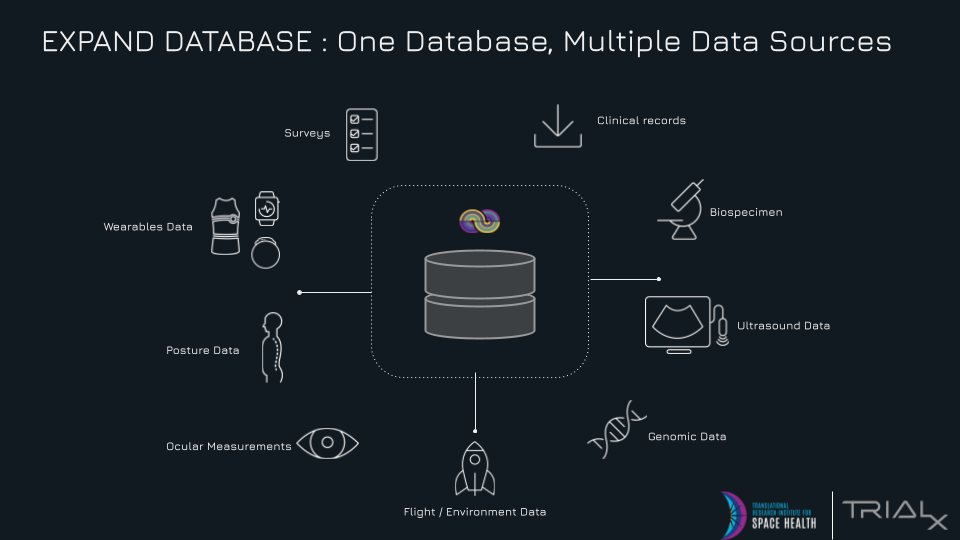
The EXPAND Database aggregates biomedical and clinical data from multiple space missions, enabling cross-mission comparisons and long-term astronaut health tracking. Developed in collaboration with the Translational Research Institute for Space Health (TRISH), EXPAND:
- Aggregates and curates biomedical and clinical data from multiple space missions.
- Enables cross-mission comparisons and long-term tracking of astronaut health.
- Supports research into cognitive performance, sleep, and behavioral adaptation.
- Facilitates space medicine research and advanced astronaut health monitoring.
HERMES Platform
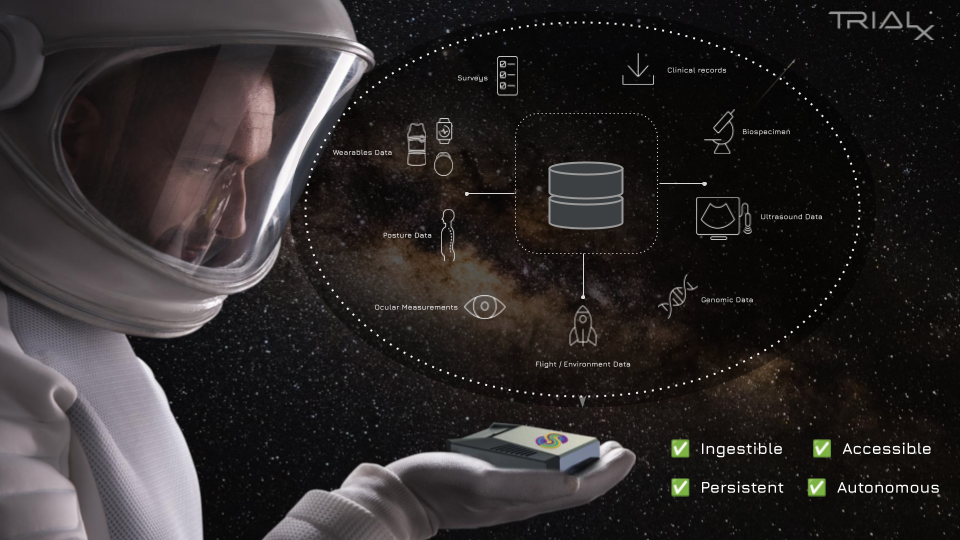
In 2023, TRISH selected TrialX to develop HERMES, an autonomous, offline-capable health data collection platform that:
- Supports real-time or delayed syncing of wearable and digital assessment data.
- Adapts for structured research protocols or routine health monitoring.
- Enables testing and validation of interventions in analog environments on Earth.
Capabilities for Researchers
With TrialX Space Health Systems, scientists can:
- Capture and analyze cognitive performance metrics.
- Monitor emotional well-being and stress indicators.
- Assess behavioral adaptation to isolation and microgravity.
Looking Ahead
Future spacesuit and EVA system designs could benefit from supporting HERMES-style data collection. Integrating EVA health telemetry into the EXPAND Database would provide more complete astronaut health profiles and strengthen research across missions.
By offering scalable, AI-powered, offline-capable systems, TrialX supports studies that advance space health research, protect astronauts on long-duration missions, and translate insights to extreme environments on Earth.
Lessons from the Audit: Why Data Integration Matters
The NASA audit demonstrates that even well-engineered life-support systems are only as effective as the data used to monitor them. The suits themselves function reliably, but data about their performance, astronaut vitals, and maintenance history remains scattered.
Unified datasets would allow NASA and partners to develop predictive models of suit degradation, detect health risks earlier, and improve astronaut safety protocols for future missions.
TrialX’s work with TRISH directly aligns with this future vision, helping build interoperable health data systems ready to operate even when communication with Earth is limited.
From Spacewalks to Future Missions
The audit’s implications go far beyond the International Space Station. As NASA, Axiom Space, ESA, CNSA, and private organizations prepare for lunar and Mars expeditions, data-driven health monitoring will become central to mission success.
Future missions will depend not only on stronger hardware but on smarter, connected systems that transform raw physiological data into actionable insights. By advancing platforms like EXPAND and HERMES, TrialX is helping bridge the gap between engineering and medicine, ensuring that the next generation of explorers stays healthy and safe as they push human boundaries further than ever before.
Find Out More
To learn more about the work TrialX is doing in space health research, visit TrialX Space Health Systems or join ongoing discussions in our Reddit community.
FAQ: Space Health Research and Astronaut Safety
- What is space health research?
Space health research studies how the human body responds to microgravity, isolation, and radiation, and uses biomedical data to improve astronaut safety and performance. - Why are NASA’s spacesuits considered health systems?
Because they regulate oxygen, temperature, pressure, and CO₂, functioning like autonomous life-support systems that sustain human physiology in extreme environments. - How does TrialX contribute to space health research?
Through systems like EXPAND and HERMES, TrialX supports decentralized, offline health data collection and integration across missions and analogs. - What data challenges does NASA face?
Biomedical and suit data are spread across incompatible systems, missions, and hardware, making unified analysis difficult. - How does AI enhance astronaut health monitoring?
AI can detect early warning signals from patterns in telemetry, wearable data, and suit sensors, even in disconnected environments. - What are the future implications of the NASA audit?
It highlights the need for modernizing both hardware and data infrastructure to protect astronauts on upcoming lunar and Mars missions. - Can platforms like EXPAND benefit Earth?
Yes. Systems built for space can support remote medicine, emergency response, and low-connectivity healthcare on Earth.
Explore TrialX Space Health Systems and see how we support space missions.