Space Health Research: Exploring Brain-Computer Interfaces for Future Missions
What if astronauts could control machines with just their thoughts?
As space travel becomes more commercial and frequent, so does the need to understand how the human brain functions in microgravity. One promising frontier in space health research is the use of brain-computer interfaces (BCIs), which are systems that translate brain signals into commands for external devices. On Earth, companies like Neuralink are already conducting early-stage clinical trials with brain implants in human participants to restore mobility and communication. This research complements ongoing efforts in space-based BCI innovation.
BCIs decode brain activity to control external devices or digital applications, and they could play a crucial role in supporting astronaut performance during long-duration missions. A recent experiment supported by the European Space Agency (ESA) and the Polish Space Agency (POLSA) set out to test whether such systems could function reliably in space. Conducted during Axiom Mission 4 (Ax-4), the recent commercial spaceflight to the International Space Station, the study, Photongrav, examined how BCIs powered by functional near-infrared spectroscopy (fNIRS) respond to the cognitive and physiological challenges of microgravity.
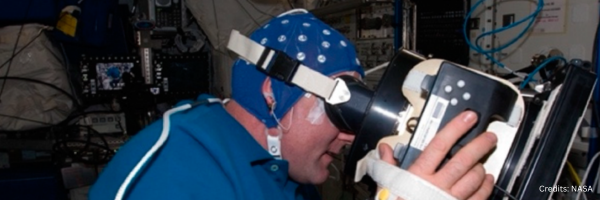
India’s first astronaut to visit the International Space Station, Group Captain Shubhanshu Shukla worked with Polish astronaut Sławosz Uznański-Wiśniewski, to help optimize signal quality and calibrate hardware as Uznański-Wiśniewski wore a Bluetooth-connected neurocap to capture brain activity inside the Columbus laboratory module.
The research team is collecting brain activity data before, during, and after flight to determine if neurocognitive signals remain strong enough to support human-computer interaction in space environments. These insights are not only critical to astronaut health but also have potential applications in medical and assistive technologies here on Earth.
Why Brain-Computer Interfaces Matter in Space Health Research
In space, astronauts experience stress, isolation, disrupted sleep, and altered cognition. A reliable BCI system could allow hands-free control of spacecraft systems, real-time mental state monitoring, and cognitive support during extended missions. Before such tools can be deployed, scientists must assess how these systems perform in weightlessness.
Photongrav is helping answer this question by using non-invasive brain imaging to track how well astronauts can interact with BCI systems under spaceflight conditions. This experiment represents a milestone in space health research because it pairs brain signal analysis with real-time digital tasks in orbit.
fNIRS: A Portable Brain Imaging Tool for Space
Functional near-infrared spectroscopy (fNIRS) is a lightweight, wearable brain imaging technology. It measures brain oxygenation and blood flow, which are linked to neural activity. Unlike MRI or EEG, fNIRS systems are portable and well suited for space where weight, power, and space are limited.
Photongrav uses fNIRS to gather neural and psychological data across the entire spaceflight timeline. This helps researchers monitor how brain function evolves in microgravity and whether these changes affect how astronauts use and respond to BCI technology.
Where TrialX Fits In: Powering Space Health Research
At TrialX, we are building the digital infrastructure that enables researchers to scale space health research and collect data in extreme, low-connectivity environments. Our platform is designed to meet the unique needs of biomedical studies in space, including experiments like Photongrav.
This includes the EXPAND Database and Biorepository, a centralized research platform developed in collaboration with the Translational Research Institute for Space Health (TRISH), built to aggregate, curate, and analyze biomedical and clinical data from commercial spaceflights. It allows researchers to compare outcomes across missions and track longitudinal changes in astronaut health, including those related to radiation exposure, sleep, cognition, and stress.
In addition, we are supporting the development of HERMES, a platform funded by TRISH to enable autonomous health data collection in space. In 2023, TrialX was selected by TRISH to develop this system to improve healthcare delivery and data management for spaceflight participants and researchers.
Key features include:
- Real-time or delayed syncing of biometric and cognitive data
- Support for wearable devices, sensors, and digital assessments
- Compatibility with both operational health monitoring and long-term research protocols
While not currently involved in the Photongrav study, this type of BCI research highlights how platforms like ours could support future space neuroscience experiments. Brain activity data recorded using fNIRS can be securely collected onboard and, when connectivity allows, transmitted to Earth for long-term analysis. In future missions, such data could be integrated into TrialX’s EXPAND database to support deeper insights into human cognition in space.
Bridging Research in Orbit and on Earth
The value of BCI research is not limited to astronauts. Studying these systems in microgravity helps improve their performance in real-world applications, including:
- Stroke rehabilitation
- Assistive devices for people with mobility impairments
- Real-time mental health monitoring in isolated or high-stress environments
The Photongrav experiment marks an important step in our understanding of how the human brain adapts to space. It combines advanced neuroimaging, cognitive science, and autonomous digital infrastructure to ask bold questions about the future of space health research.We are proud to support this new era of research. Our platforms are helping scientists design and deploy studies that are scalable, secure, and scientifically rigorous, whether in orbit or on the ground. With the right tools in place, we can continue to push the boundaries of what is possible for brain-computer interfaces and space health innovation.