Space Health Research on Ax-4: How Do Astronauts Interact with Electronic Displays in Space?
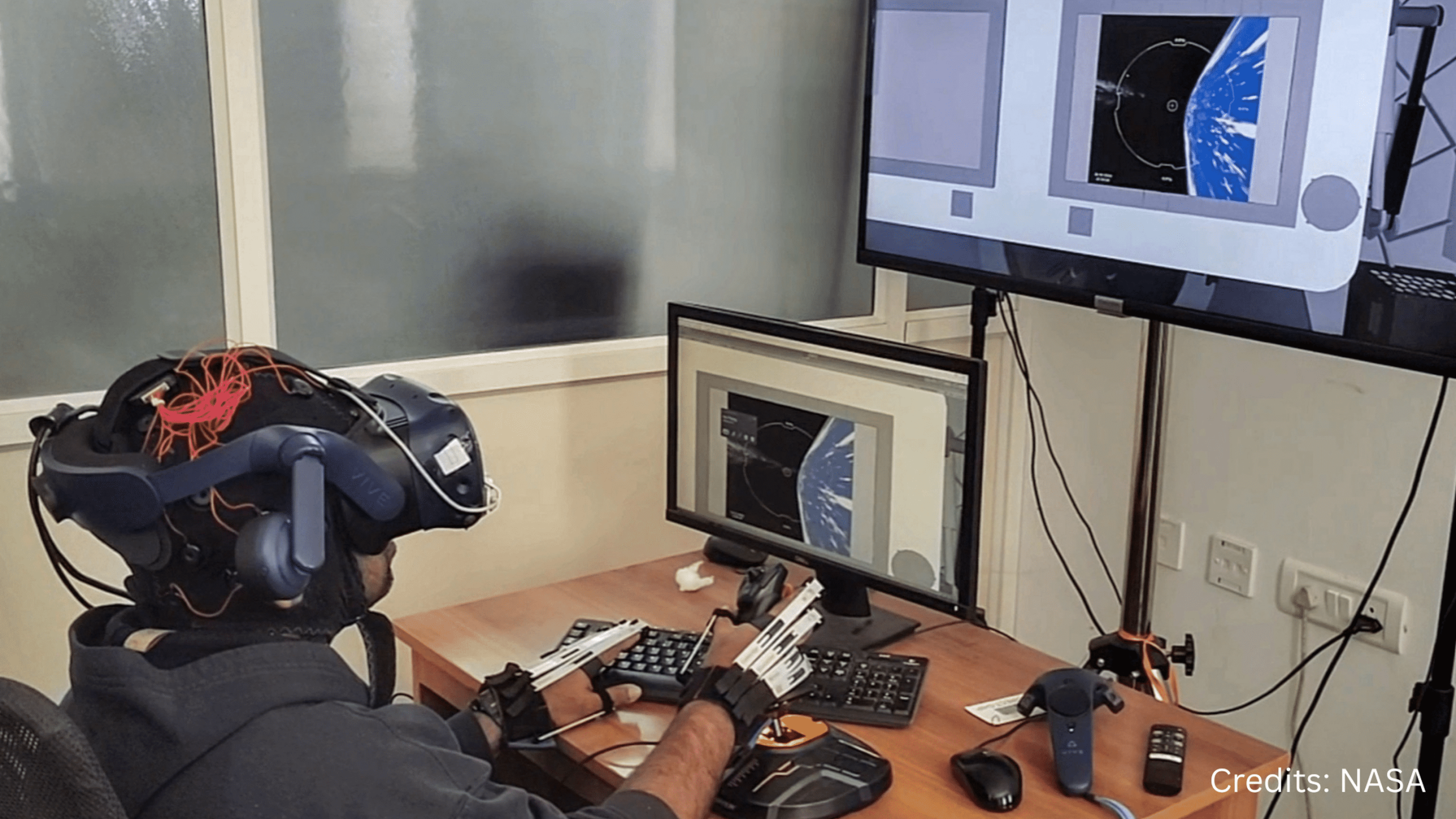
When astronauts are 400 km above Earth, floating in the microgravity environment of the International Space Station, even everyday tasks like looking at a screen become more complex than they are on Earth.
The Ax-4 mission, a collaboration between NASA, Axiom Space, and the Indian Space Research Organisation (ISRO), is taking a closer look at this challenge through the Voyager Displays experiment. This space health research study explores how microgravity affects the way astronauts interact with computer screens, offering insights that could transform the design of future spacecraft interfaces.
Understanding the Voyager Displays Experiment
What Is Voyager Displays?
Voyager Displays is an ISRO-developed study aboard the Ax-4 mission to the International Space Station. It investigates the physical and cognitive effects of using computer screens in microgravity, focusing on how astronauts perform pointing tasks, maintain gaze fixation, and execute rapid eye movements.
Why Study Screens in Space?
On Earth, we take screen use for granted. In space, screens are mission-critical tools for navigation, experiment control, and communication. Microgravity can alter:
- Hand-eye coordination.
- Muscle control during fine motor tasks.
- Eye movement patterns and visual processing.
Understanding these differences can improve astronaut safety and mission efficiency.
The Science Behind Human-Computer Interaction in Microgravity
Physical Effects
Without gravity as a stabilizing force:
- Pointing accuracy can be reduced.
- Movements may feel “floaty” or less anchored.
- Reaction times for visual-motor tasks can shift.
Cognitive Effects
Screens in microgravity can influence mental workload:
- Longer fixation times and altered saccades.
- Increased effort to interact with complex visual data.
- Potential links between visual strain and stress levels.
The Ax-4 Mission’s Role in Advancing Space Health Research
Collaboration Across Borders
Ax-4 is one of the most research-intensive Axiom Space missions yet, with around 60 experiments from 31 countries. Voyager Displays reflects how international partnerships accelerate space health advancements.
Leading the study is Gp. Capt. Shubhanshu Shukla, pilot of the SpaceX Dragon spacecraft. His work connects directly to ISRO’s Gaganyaan Mission, where human-computer interaction research could directly impact astronaut safety.
Implications for Future Space Missions
Designing Better Spacecraft Interfaces
Insights from Voyager Displays can help engineers:
- Reduce operational errors in space.
- Design intuitive, low-strain user interfaces.
- Adapt controls to microgravity environments.
Supporting Long-Duration Missions
For Moon or Mars missions, astronauts may depend on screens for months or years. Optimized displays could prevent cognitive fatigue and improve mission outcomes.
Applications on Earth
While Voyager Displays is designed to study astronauts in microgravity, its findings can also inform everyday life on Earth. By understanding how screen use affects vision, motor skills, and cognitive processing in extreme environments, researchers can:
- Improve the design of electronic devices to reduce eye strain and fatigue for people who spend long hours on screens.
- Provide new insights into how visual workload impacts focus and stress, which could help educators, parents, and healthcare providers guide healthier screen use for children and adults.
This means that results from space could directly contribute to better guidelines for safe screen time on Earth, a topic of concern for parents and professionals alike.
How TrialX Supports Space Health Research
TrialX is developing the digital infrastructure that enables scientists to conduct space health research in challenging, low-connectivity environments such as the International Space Station. Our platforms are designed to address the complexities of collecting, managing, and analyzing biomedical data in orbit.
A key part of this infrastructure is the EXPAND Database and Biorepository, created in collaboration with the Translational Research Institute for Space Health (TRISH). This centralized platform aggregates and curates biomedical and clinical data from commercial spaceflight missions. Researchers can use it to compare outcomes across missions and track long-term changes in astronaut health, including cardiovascular function, muscle mass, bone density, cognitive performance, and other physiological measures. These datasets could also be studied alongside operational data from systems like Voyager Displays to better understand how spacecraft conditions affect human health.

We are also building HERMES, a TRISH-funded platform for autonomous health data collection in space. TrialX was selected by TRISH in 2023 to develop HERMES, which is designed to enhance both medical care and scientific research for spaceflight participants. It enables real-time or delayed syncing of biometric and cognitive data, integrates with wearable devices and digital assessments, and can be adapted for routine health monitoring as well as structured research protocols.

Although TrialX is not directly involved in the development of Voyager Displays, our remote health data collection and real-time research monitoring tools could complement such systems. In a microgravity study, for example, they could be used to capture and analyze:
- Eye-tracking data
- Cognitive performance metrics
- Stress and well-being indicators
FAQs
Q: Why is screen interaction in space different from Earth?
In microgravity, muscle coordination and eye movement change, affecting accuracy and speed when using screens.
Q: What is microgravity’s impact on human vision?
It can alter fixation times, saccadic eye movements, and even cause fluid shifts in the eyes.
Q: How will Voyager Displays data be used?
To design safer, more user-friendly spacecraft computers and mission interfaces.
The Voyager Displays experiment proves that space health research is about more than just radiation or muscle loss. It is also about how astronauts interact with their tools. By studying human-computer interaction in microgravity, researchers can design spacecraft that are safer, more efficient, and more human-friendly, paving the way for long-term human spaceflight.
Discover how TrialX’s Space Health Systems can power your next space health study.