Space Health Research and Axiom-4: Building Better Mental Health Support Systems
If we can protect an astronaut’s body in space, how do we safeguard their mind?
Space health research is no longer limited to monitoring heart rates or muscle loss. On missions like Axiom-4, astronauts face one of the toughest challenges of long-duration spaceflight—protecting their mental health in microgravity. The isolation, confinement, and disrupted sleep cycles of space can lead to stress, cognitive fatigue, and reduced performance.
As humanity prepares for deeper missions beyond Earth, mental health is becoming a central focus of space medicine and behavioral health in space. Projects like AstroMentalHealth, tested during analog missions such as ESA’s LunAres habitat in Poland, are helping researchers understand and support astronauts in real time.
AstroMentalHealth: Studying Mental Health in Space
The AstroMentalHealth project is advancing space health research by studying astronauts’ cognitive, emotional, and behavioral well-being during spaceflight. Focusing on the International Space Station and mirrored analog missions on Earth—such as the Terra Nova mission at Poland’s LunAres Research Station—the project helps researchers understand how isolation, microgravity, and technological environments impact mental health.
Data is collected through multiple methods:
- Questionnaires to assess stress, mood, and cognitive function before, during, and after missions.
- Interviews and video diaries to capture personal experiences, coping strategies, and emotional responses.
- Observation of facial expressions to identify subtle changes in emotion and social interaction.
By combining quantitative and qualitative approaches, AstroMentalHealth provides a holistic view of astronaut mental health monitoring and informs the development of support systems for long-duration missions.
Axiom‑4: Conducting Mental Health Research in Space
One of the most notable implementations of AstroMentalHealth was during the Axiom‑4 mission, which launched on June 25, 2025, to the International Space Station. The mission not only expanded commercial spaceflight opportunities but also highlighted the growing focus on behavioral health in space and space medicine research.
The Axiom‑4 crew—Commander Peggy Whitson, Group Captain Shubhanshu Shukla, Mission Specialist Tibor Kapu, and Polish astronaut Sławosz Uznański‑Wiśniewski—participated in the study, providing valuable data on cognitive performance, emotional states, and behavioral health during long-duration spaceflight.
Activities conducted during the mission included:
- Cognitive assessments to track attention, memory, and problem-solving in microgravity.
- Digital diaries to capture emotions, stress levels, and coping mechanisms.
- Neurofeedback tools to help astronauts self-regulate mood and focus.
- Isolation studies simulating long-duration mission stressors.
Polish astronaut Sławosz Uznański‑Wiśniewski led the AstroMentalHealth study aboard the International Space Station, coordinating data collection and providing insights that will guide future missions and broader space health research initiatives.
Analog Missions: Terra Nova at LunAres
To complement the space-based study, a mirror mission took place at LunAres Research Station in Poland. This analog environment simulated the International Space Station, allowing researchers to study behavioral and cognitive responses under controlled isolation.
- The Analog International Space Station crew spent three weeks in isolation, simulating current International Space Station crew conditions.
- The Analog Axiom crew mirrored the Axiom‑4 mission composition, participating for two weeks to replicate real-time changes in crew dynamics.
- Data collection included cognitive tasks, emotional diaries, and observational analysis, providing insights that help generalize spaceflight findings to broader contexts.
This dual approach ensures the AstroMentalHealth project captures both real microgravity effects and Earth-based analog behaviors, improving the accuracy of mental health interventions for astronauts.
From Space to Earth: AstroMentalHealth and Mental Health Innovation
The insights gained from the AstroMentalHealth project are driving innovations in space health technology and astronaut mental health monitoring systems. By analyzing behavioral data, facial expressions, and cognitive performance, researchers are able to:
- Develop remote mental health monitoring tools for astronauts and isolated populations on Earth
- Create personalized psychological support programs for long-duration missions
- Enhance space health data platforms for multi-modal, offline-capable research
What happens in space doesn’t stay in space. These advances are directly relevant to life on Earth, benefiting:
- Healthcare workers under stress in high-pressure environments
- Remote workers dealing with isolation and disconnection
- Patients with chronic conditions who require continuous cognitive and emotional support
By bridging astronaut mental health research with practical applications on Earth, space health research is helping build tools that improve mental resilience, ensuring well-being both off-planet and at home.
How TrialX Space Health Systems Support Space Health Research
TrialX Space Health Systems provide the digital infrastructure that enables scientists to conduct space health research and space health studies in challenging, low-connectivity environments like the International Space Station. Platforms like EXPAND and HERMES are designed to handle complex biomedical and behavioral data, helping researchers study cognitive performance, stress, and emotional well-being in microgravity.
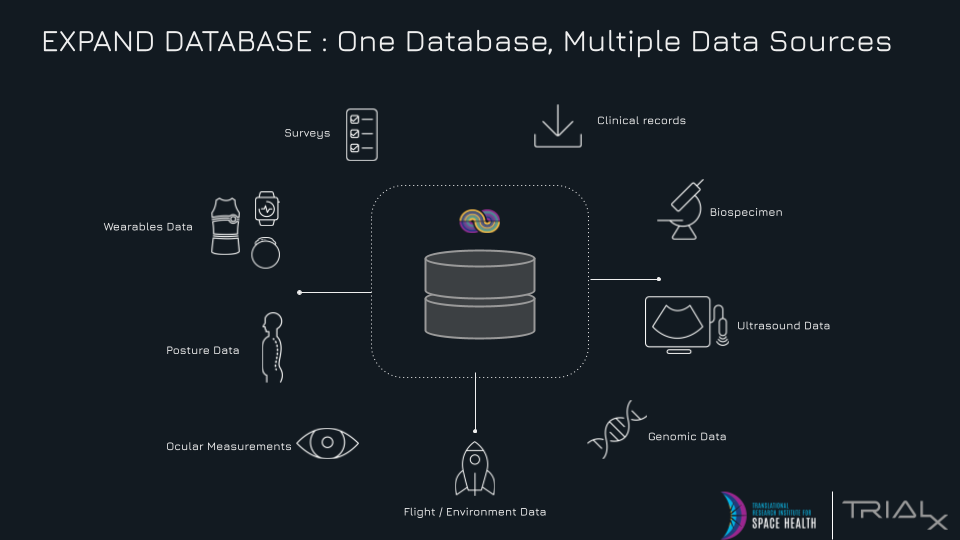
The EXPAND Database and Biorepository, developed in collaboration with the Translational Research Institute for Space Health (TRISH), aggregates and curates biomedical and clinical data from multiple space missions. Researchers can use these datasets to compare outcomes across missions, track long-term changes in astronaut health, and explore factors affecting cognitive function, sleep, and behavioral adaptation.
TrialX was also selected by TRISH in 2023 to develop HERMES, a platform for autonomous health data collection in space. It enables real-time or delayed syncing of wearable and digital assessment data and can be adapted for structured research protocols or routine health monitoring. These capabilities make it possible to test and validate interventions in analog environments on Earth, helping projects like AstroMentalHealth benefit from broader technological support for mental and behavioral health research.
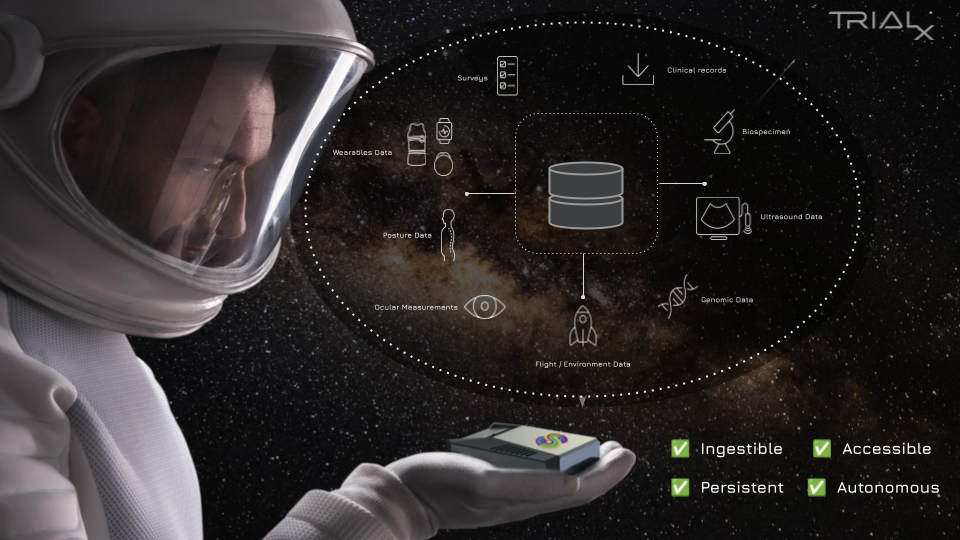
TrialX Space Health Systems provide tools to capture and analyze:
- Cognitive performance metrics
- Emotional well-being and stress indicators
- Behavioral adaptation to isolation and microgravity
By offering scalable, AI-powered, and offline-capable health systems , TrialX Space Health Systems help advance space health research and space medicine, supporting the development of strategies that protect astronauts’ mental and physical well-being on long-duration missions and inform extreme-environment applications on Earth.
FAQ: Space Health Research and AstroMentalHealth
Q: What is space health research?
A: Space health research studies the physiological and psychological well-being of humans in space, including cognitive performance, stress management, and adaptation to microgravity.
Q: How does AstroMentalHealth support astronaut mental health?
A: The project collects behavioral, emotional, and cognitive data via questionnaires, video diaries, and neurofeedback tools, informing interventions to improve well-being during missions.
Q: What role do analog missions play in space health research?
A: Analog missions simulate spaceflight conditions on Earth, allowing researchers to study isolation, microgravity-like stressors, and crew dynamics to refine strategies before real missions.
Q: How can TrialX platforms support space health research?
A: TrialX provides AI-powered, offline-capable platforms like EXPAND and HERMES, part of TrialX Space Health Systems, enabling researchers to capture, store, and analyze biomedical and cognitive data in low-connectivity environments.
Q: How does space health research benefit Earth-based healthcare?
A: Technologies and interventions developed for astronauts can be adapted for remote or extreme environments on Earth, improving access to mental health care and monitoring for isolated populations.
As space missions become longer and more complex, understanding and supporting astronaut mental health is critical. Projects like AstroMentalHealth provide valuable insights, while platforms like TrialX Space Health Systems empower researchers to capture, analyze, and act on health data in real time. Together, these efforts are shaping the future of space health research and space medicine, ensuring astronauts can thrive both mentally and physically during long-duration missions.
Explore how TrialX is enabling next-generation space health studies and request a demo to see our technology in action.