Artemis II and Human Rated Spacecraft: Why Space Health Research is Getting a First Class Ticket on the Next Artemis Mission

Human spaceflight is moving back into deep space. With Artemis II, astronauts will soon leave low Earth orbit for the first time since the Apollo missions and once again travel outside Earth’s protective magnetic field.
Artemis II is no longer a distant milestone. It is now in advanced pre-launch operations, with the integrated Space Launch System and Orion spacecraft completing wet dress rehearsals at Kennedy Space Center. A helium flow issue in the rocket’s upper stage prompted NASA to roll the vehicle back to the Vehicle Assembly Building for troubleshooting, eliminating the March launch window. NASA is now targeting launch opportunities beginning in April 2026, pending final readiness assessments.
What makes this mission especially noteworthy is not only where it goes, but what it will validate along the way. Artemis II is not a routine mission of scientific research. Rather, it is a commissioning flight for both a new class of vehicle(s) and a supply delivery route to the lunar surface.
In the bigger picture, the Artemis missions will function similar to site-survey missions for other high-risk infrastructure projects, such as activities in the Antarctic or the commissioning of an oil drilling platform in the ocean. The first phases of such activities often include missions to characterize the operating environment (i.e. high seas, arctic snow, or lunar regolith), followed by exercises to establish life-support systems and a base of operations (i.e. scuba gear, thermal protection, radiation exposure), and which eventually establish an operational tempo for repeatable ferry operations as equipment and supplies and personnel are delivered onsite (docks, airfields, landing pads).
The health and performance data collected on this upcoming mission are intended to confirm that decades of research and operations from the Space Shuttle program and the International Space Station remain valid beyond low Earth orbit. For space health research, Artemis II represents an opportunity to validate existing physiological models, countermeasures, and operational assumptions and calibrate them under real deep-space conditions.
Artemis II as a Human Health Research Mission
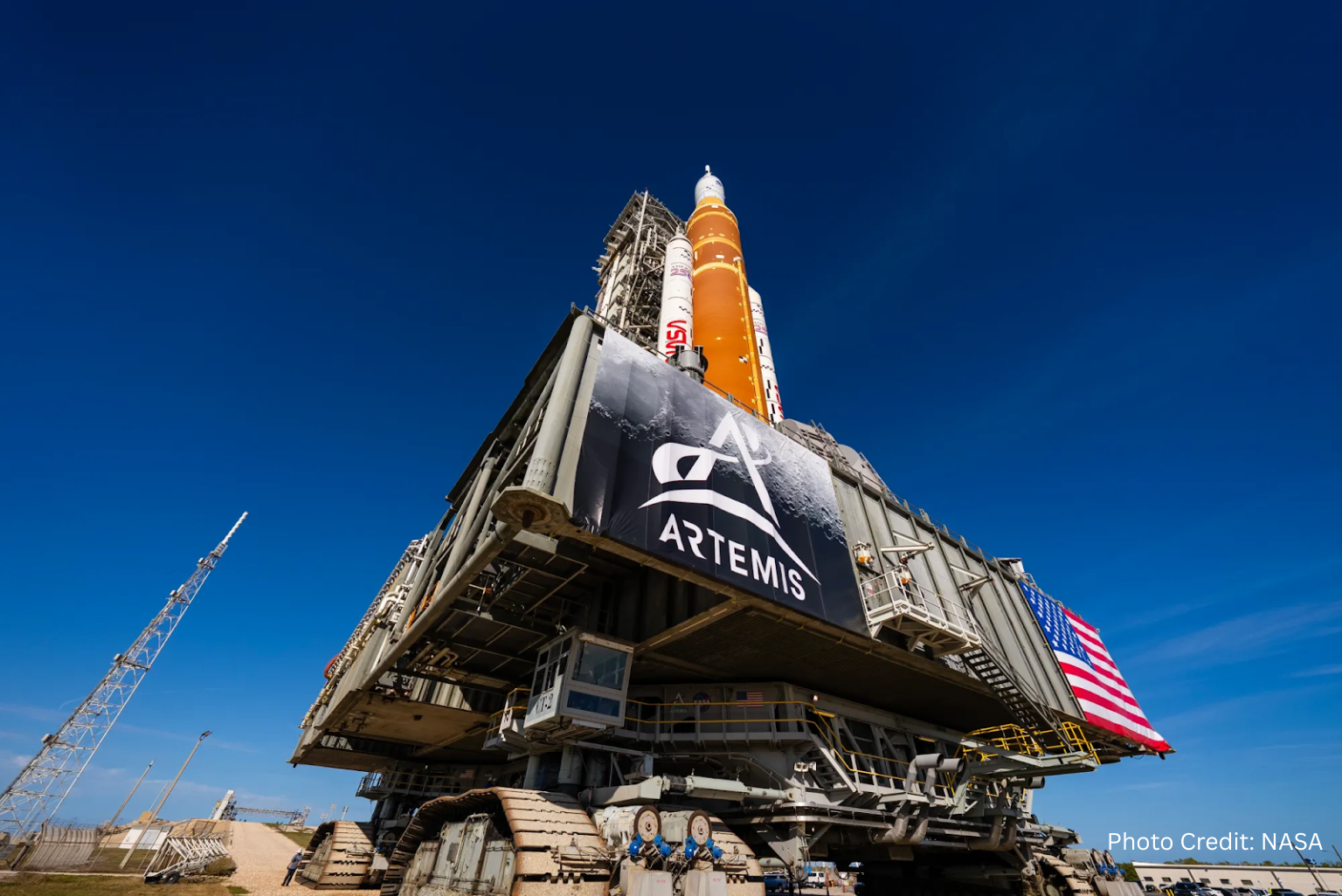
Unlike Artemis I, which was fully autonomous, Artemis II will have astronauts onboard, who will serve as both operators and research participants, providing data that confirm vehicle, route, and environmental stability.
The mission lasts roughly ten days. That duration is deliberate, and doesn’t include landing. There will be opportunity for exploration on the lunar surface in future missions. For this mission, Artemis II focuses on validating short-duration deep-space ferry operations with live astronauts. The spacecraft will perform a lunar flyby to survey the route and confirm that all systems operate as expected.
Most human spaceflight research over the last two decades has taken place aboard the International Space Station (ISS). The ISS operates within Earth’s magnetic field and does not reproduce the radiation profile, communication delays, or translunar trajectory associated with deep-space operations. Artemis II validates that human performance and vehicle systems remain stable under these different environmental and operational parameters.
The Artemis II crew includes Reid Wiseman, Victor Glover, Christina Koch, and Jeremy Hansen. In addition to their operational roles, all four astronauts contribute structured performance and biomedical data that will be used to confirm that their short-duration trip through the Van Allen belts and into deep-space remains safely within expected physiological bounds.

Continuous Monitoring of Performance, Sleep, and Stress
A central objective of Artemis II is vehicle commissioning, which is intended to confirm that vehicle systems and crew performance operate as expected during lunar ferry operations. Astronauts will use wearable devices and complete structured assessments to capture:
- Radiation exposure
- Sleep quality and circadian alignment
- Physical activity and fatigue
- Cognitive performance and reaction time
- Stress levels and team dynamics
These measurements will be continuous through the mission, rather than episodic or on-demand. That difference matters. High-resolution data makes it possible to detect subtle changes in cognition, mood, and coordination that could affect mission safety.
This approach mirrors challenges increasingly seen in Earth-based research in the Antarctic and other remote locations. Participants are remote. Monitoring must be passive. Data needs to be captured reliably without constant oversight. Artemis II provides a clear example of how continuous monitoring works in remote locations where real-time intervention is limited or impossible.
Past Apollo missions indicate that short-duration deep-space flight does not produce dramatically different physiological responses compared to low Earth orbit. Expectations are that this should be an uneventful 10 day flight.
That being said, there are some mission-specific stressors that differentiate the Artemis II mission from visits to the International Space Station that analysts and health researchers will be interested in: orbital transfer burns (approximately 0.2 to 1.5g), passage through the Van Allen radiation belts, exposure to deep-space cosmic radiation, communication blackout windows, and the behavior of a newly flown spacecraft under full system load. Artemis II will establish baseline performance under most all of these conditions.
Immune Function and Biomarkers in Deep Space
Immune monitoring during Artemis II is less about the lunar flyby itself and more about environmental validation of a newly commissioned vehicle. Full pressurization and repeated vacuum exposure under real operational conditions introduce variables that cannot be completely simulated on the ground. Material off-gassing, seal performance, waste system integrity, particulate accumulation, and volatile compound release are evaluated indirectly through biomedical and environmental monitoring.
Artemis II includes structured biological sample collection before and after flight, paired with inflight performance and behavioral data, to examine:
- Immune system activation and suppression
- Stress-related biomarkers
- Patterns of physiological adaptation and recovery
These signals are analyzed together rather than in isolation. Immune response, sleep disruption, cognitive fatigue, and stress are treated as connected outcomes of operating within a new vehicle and operational environment.
Artemis II is also flying during the current solar maximum phase of the approximately 11-year solar cycle. Elevated solar activity increases the probability of space weather events such as solar flares and coronal mass ejections, which could cause any number of problems, ranging from malfunctioning equipment to radiation burns and long term molecular damage and cancer. Even in a short-duration mission, flying through deep space outside the Earth’s magnetic field provides an opportunity to validate radiation safety models.
Cellular-Level Insight Through Organ-on-a-Chip Research
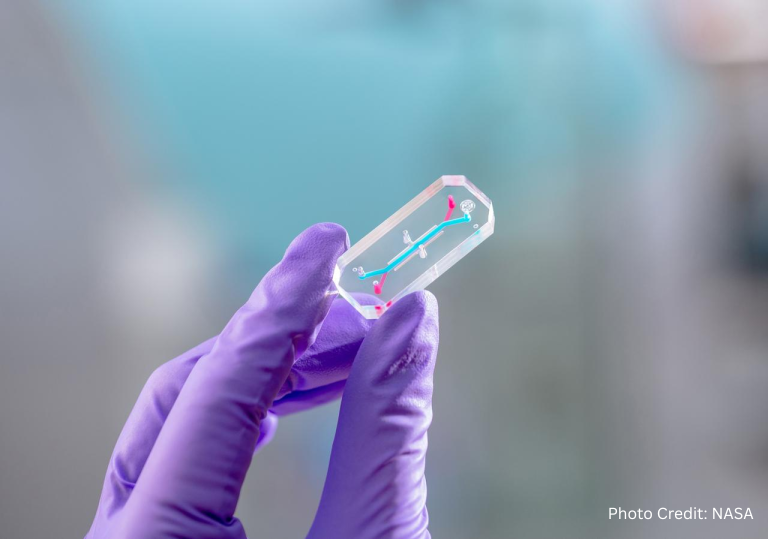
While Artemis II focuses primarily on vehicle and environmental validation, complementary biomedical tools are also being advanced for future missions.
One of the more advanced biomedical efforts aligned with the Artemis program is AVATAR, a research initiative that uses organ-on-a-chip technology to study how human tissues respond to spaceflight stressors.
Bone marrow cells derived from each astronaut are used to create personalized tissue models. These models are exposed to space-relevant conditions and compared against matched Earth-based controls. The goal is to isolate how radiation and mission stress affect blood cell development and immune response at the cellular level.
Organ-on-a-chip methods allow this type of analysis without invasive procedures on the crew and provide a framework for future longer-duration missions where tissue-level insight may become more critical.
Standard Measures and Cross-Mission Comparability
Artemis II also contributes to NASA’s effort to standardize human health data collection across missions. Standardization allows researchers to:
- Track trends over time rather than isolated events
- Compare astronaut experiences across different mission profiles
- Reduce variability introduced by inconsistent protocols
- Understand how space flight impacts astronauts’ long term health
Artemis II observations will be interpreted against historical data from Apollo and short-duration Space Shuttle missions of similar length. The objective is to validate assumptions rather than direct comparison. Confirmation that responses remain within historically observed bounds strengthens confidence in the Orion spacecraft, linking low Earth orbit experience with future lunar and Mars missions.
Without consistent measures, comparisons across missions break down. Artemis II reinforces the importance of designing research systems with comparability built in from the start.
Why Artemis II Matters Beyond Spaceflight
The constraints shaping Artemis II are not unique to space. Many are increasingly common in Earth-based health research in the Antarctic, maritime industries, and in developing nations. Health systems in these locations frequently are constrained by:
- Small, highly defined participant cohorts
- Remote or resource-limited settings
- Intermittent connectivity
- Heavy reliance on passive data collection
- Longitudinal study designs
Space health research has operated under these constraints for decades. This makes Artemis II an important case study for how structured monitoring can produce interpretable, high-quality data even in operationally constrained environments.
Implications for Health Research Infrastructure
Artemis II establishes a baseline for how health systems must function as lunar operations scale from survey mission to surface exploration. Eventually, these missions may even scale to include industrial applications such as mining and manufacturing, or even space tourism. As missions extend to longer durations and higher flight frequency, several requirements become non-negotiable:
- Data collection must remain continuous rather than episodic
- Multiple data streams must integrate with clean handoff of passengers and data between mission segments
- Systems must function with limited bandwidth and delayed communications
- Standardization must be built in early
These deep-space requirements are already influencing how space agencies design and conduct health research, and health studies on Earth are quickly adopting many of the same learnings. Artemis II makes clear that next-generation research infrastructure must function reliably even when connectivity and oversight are not guaranteed.
How TrialX Supports Modern Space Health Research
TrialX supports space health research through stewardship of space health data repositories, development of aerospace grade data-collection and health monitoring systems, and post-mission data analysis. At the research level, these activities are enabled by data continuity, comparison, and long-term analysis across missions.
EXPAND Database & Biorepository
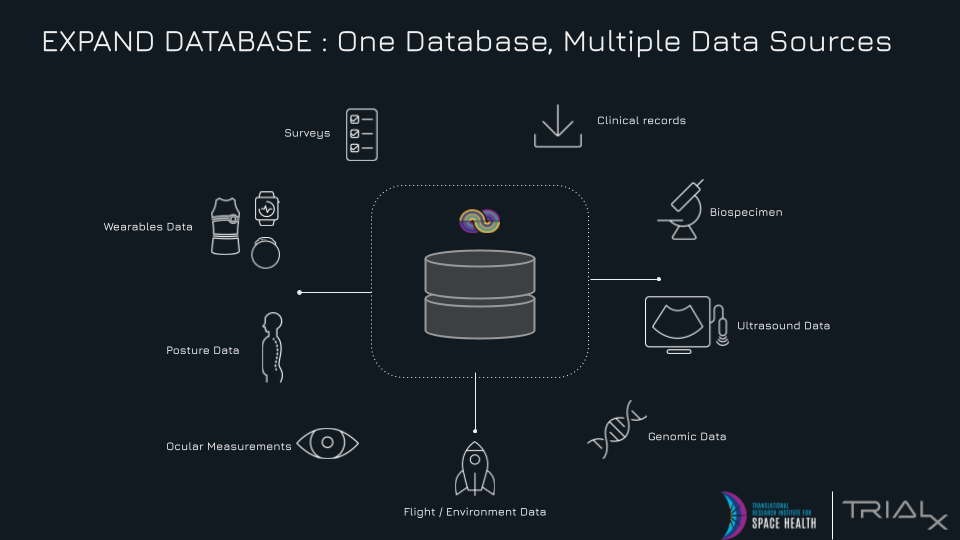
The EXPAND Database aggregates biomedical and clinical data from multiple space missions, enabling cross-mission comparisons and long-term tracking of astronaut health. Developed in collaboration with the Translational Research Institute for Space Health (TRISH), EXPAND’s design goals include:
- Aggregates and curates biomedical and clinical data from multiple space missions
- Enables cross-mission comparisons and long-term tracking of astronaut health
- Supports research into cognitive performance, sleep, and behavioral adaptation
- Facilitates space medicine research and advanced astronaut health monitoring
As Artemis missions move beyond low Earth orbit, comparing health data across different mission profiles becomes more important. EXPAND treats astronaut health data as part of a growing, standardized body of research rather than isolated mission outputs.
While EXPAND focuses on aggregation and long-term analysis, reliable data capture at the source remains essential.
HERMES Platform
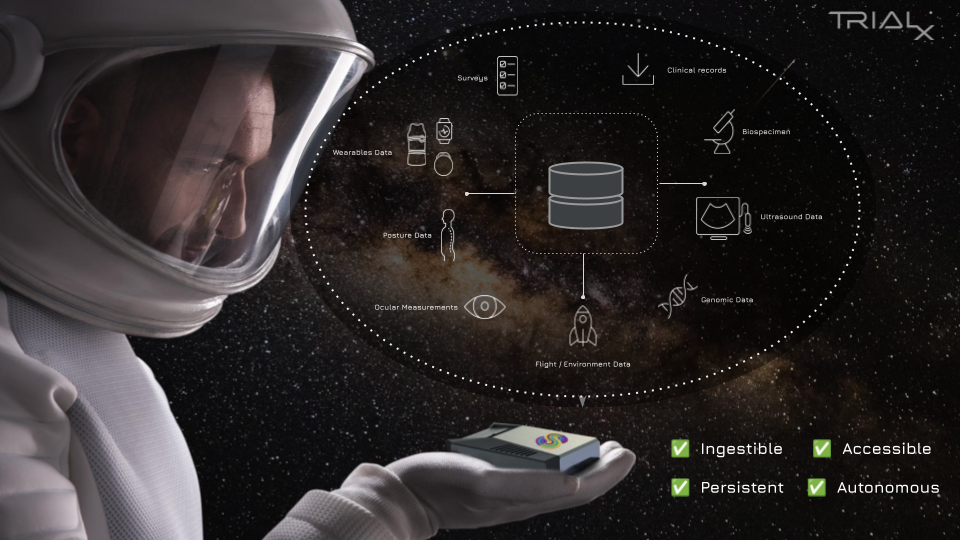
In 2023, TRISH selected TrialX to develop HERMES, an autonomous, offline-capable health data collection platform built for environments where continuous connectivity cannot be assumed. HERMES design goals include:
- Support for real-time or delayed syncing of wearable and digital assessment data
- Adapt to structured research protocols or routine health monitoring
- Enable testing and validation of interventions in space-analog environments on Earth
HERMES is designed around the same constraints faced during deep-space missions. Limited bandwidth, delayed communication, and the need for consistent protocol execution without constant ground involvement define much of modern space health research.
Capabilities for Researchers
In space health research, where decisions may need to be made with limited diagnostic access, TrialX Space Health Systems enable researchers to:
- Capture and analyze longitudinal cognitive performance metrics
- Monitor emotional well-being and stress indicators over time
- Assess behavioral adaptation to isolation, confinement, and microgravity
These capabilities support research models that rely on continuous measurement and long-term insight rather than short-term observation. The same principles apply to extreme or remote research settings on Earth.
Artemis II Mission Analysis
As Artemis II establishes biomedical and operational baselines, attention will soon shift to post-mission analysis. NASA has already begun engaging with the space health research community, by soliciting ideas on how to analyze the mission data through a Request for Information (RFI). TrialX has responded to this solicitation, by submitting for public review a plan of analysis for the Artemis II mission data that focuses on radiation dosage effects, emphasizing
- within-subject longitudinal tracking of before-and-after biomarkers
- mission-segment aligned time-series analysis
- envelope validation with Apollo missions
- Bayesian prior-informed uncertainty bounding
Regardless of who is tapped to do the official analysis, TrialX stands ready to engage with and assist in any data analysis; through direct work or stewardship of the EXPAND database.
A Crewed Lunar Spacecraft Represents a Big Step Forward for Space Health Research
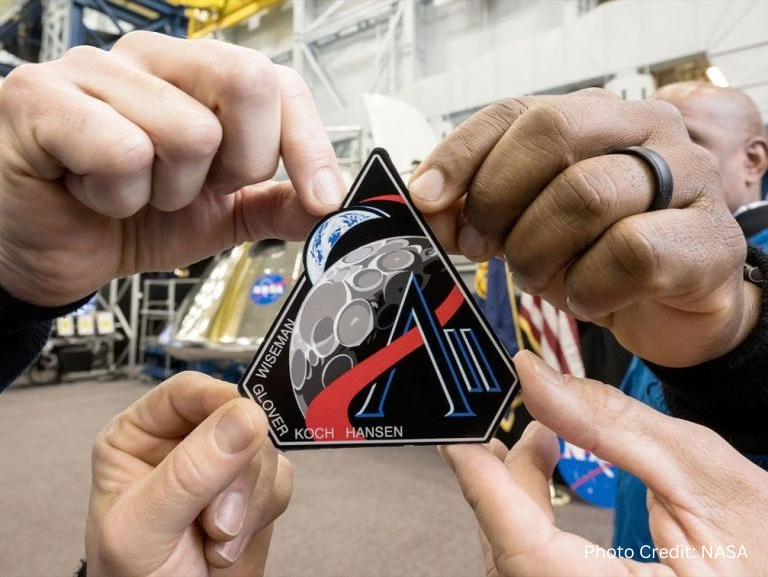
Artemis II is a significant step toward sustained human presence beyond Earth. The health data that the four astronauts will be risking their lives to collect on this mission will establish baselines for crew safety, mission design, and risk models for decades to come.
The missions that follow will build upon these baselines. As lunar operations expand, health infrastructure will need to extend beyond Earth based assumptions and incorporate autonomous systems, environmental monitoring, mission-segment handoffs and transfers, and more.
To get to that future, the Artemis crew will first need to fly the Orion spacecraft on its maiden voyage, through the Van Allen belts, risking the chance of solar flares and coronal mass ejections, around the far side of the moon, and back.
Along the way, they will confirm that life-support and physiological models are all working within expected ranges, and that operating protocols and countermeasures are all working as expected. If all that can happen safely and without incident, the result will be the establishment of a translunar supply route for long term activity on the moon.
And the Artemis II mission is the commissioning step that makes that possible.
Frequently Asked Questions
Why is Artemis II important for space health research?
Artemis II is the first crewed mission in decades to validate human health and performance beyond low Earth orbit using modern monitoring systems. Its primary objective is to confirm that existing models and operational procedures remain valid during translunar voyages.
Is Artemis II primarily a research mission?
Artemis II is primarily a commissioning mission for Orion and lunar operations. Biomedical data are collected to validate vehicle, environmental, and physiological assumptions rather than to drive discovery-oriented research.
What types of health data are collected on Artemis II?
Data includes radiation exposure, sleep and circadian rhythm measures, cognitive performance and reaction time, stress indicators, immune biomarkers, and environmental validation metrics.
How does Artemis II differ from ISS health studies?
The ISS operates within Earth’s magnetic field. Artemis II operates outside it and includes translunar trajectory phases, radiation belt transit, communication blackout periods, and full-system validation of a newly flown spacecraft.
How does Artemis II influence future lunar missions?
Artemis II establishes operational and biomedical baselines that inform risk models, countermeasures for use in emergencies, and mission design for subsequent lunar and cislunar missions.